Naval power in Asia in Friday’s ISN Podcast interview with Richard A Bitzinger.
This week we’ll be looking at: the nexus between FIFA decisions and world politics, EU’s approach to illegal immigration, the ongoing Munich Security Conference, and oil politics in the wake of Egypt’s political crisis. Stay tuned.
More than a week later, Tahrir Square is still full of demonstrators, photo: Mashahed/flickr
With rumors abound that Mubarak will have to accept a US brokered deal to step down today (amid fresh waves of protests in Cairo), the situation in Egypt is developing so fast that accurate and constantly updated information is key to understanding the present and possible future of this Arab stalwart. What will this day bring to the streets of Cairo? More horrific violence or a sense of renewed resolve and purpose? Will Friday, 4 February 2011, mark the end of Mubarak’s three decade rule?
In addition to pointing you to resources we hold in the ISN Digital Library on Egypt in last week’s post (lots of interesting stuff analyzing the background to the current crisis), we’d like to give you a taster of what we’re monitoring here at the ISN for the newest information on the crisis as it unfolds, day by day, hour by hour.
The best way to stay up to date is to follow Twitter streams: Search for #Egypt or #Cairo to get a live stream of tweets relating to the protests or follow Al Jazeera’s twitter stream which is currently focused on this issue.
In warfare the term “theater” is used for the specific area where war is taking place. In Mexico “theater of the absurd” could be used for the strange and incongruous aspects that the drug war has introduced in people’s lives.
At the beginning of January 2011 the Heidelberg Institute for International Conflict Research published its yearly assessment and rated Mexico as one of the world’s six most violent nations. Judging by the conflict barometer’s criteria, Mexico is indeed a country at war. In 2010 the situation worsened considerably: There were more than 12,000 drug-related killings and Monterrey, Mexico’s wealthiest city, also succumbed to the drug war.
But does the conflict level in Mexico feel like the one reported in Afghanistan, Somalia, Iraq or Sudan? It actually does not. It is as if the war is a game of hide-and-seek with the country’s citizens. It is going on “behind” open eyes: Constantly present – in low-income neighborhoods, suburbs or on highways leading North – yet when one turns round, there are only traces to be seen. The effects of this latent violence are bitter and its psychological consequences profound.
Future learning for defense and security professionals, photo: ISN
Almost anyone involved in large-scale education and training activities has accepted e-Learning as an established method and technology. What started with early experiments by financially powerful large enterprises and armed forces almost twenty years ago, has become available and affordable to almost any organization today.
Open-source solutions for learning management systems and the authoring of content, as well as low-cost hosted solutions, allow for the minimizing of technology investments to about zero. And based on the experiences of early adopters, the dos and dont’s, as well as successful e-Learning scenarios are widely known.
As a result, e-Learning has found its way into most educational organizations, including many committed to education in the defense and security policy sector. Everything fine and dandy then? Well, almost …
Contrary to basic language and computer training for the broader market (of professionals in general), there is hardly any off-the-shelf online-content available for more specific educational topics related to defense and security. As a result, content in this area is usually produced by educational institutes from scratch, requiring close cooperation between subject matter experts, instructional designers and multimedia specialists. It also requires a lot of time and money.
Despite this, there is more and more content being developed in support of peace and stability worldwide, often supported by funding from various sources. Although most of this content serves its key audience and goals, the return-on-investment for production, as well as the overall effect of educational campaigns might often be improved significantly: The key lies in expanding the target audience.
It's all about the taxes, photo: Chuck Simmins/flickr
Your humble blogger would have appreciated an invitation to this year’s World Economic Forum (WEF). Unfortunately, no such letter landed in my mailbox. No matter, I probably couldn’t have accepted anyhow.
The entry-level $71,000 price tag, it turns out, – travel, room, board and entertainment excluded – is a smidgen out of my league. Good thing that the WEF publication Global Risks 2011 calls attention to economic disparity (aka income and wealth inequality), both within and between countries, as the most pressing risk out there today. Are the plutocrats beginning to feel the heat?
In America, home to the highest economic inequality in the developed world today, the winds of change may have started to blow.
The American Right has for the past 30 years effectively existed as an alliance of convenience between middle-class social conservatives from the American heartland on the one hand, and members of the corporate and financial elite intent on hoarding cash on the other. The informal arrangement has proved remarkably durable, at least up until the Great Recession.*
The social conservatives got politicians who extolled the virtues of American family values, promoted constitutional bans on gay marriage and abortion, and never missed an occasion to exalt America’s exceptionalism. The corporate and financial elite got ‘Benjamins’, lots of them. To make the economics attractive, the corporate and financial elite promised what George H W Bush in 1980 mocked as ‘voodoo economics:’ tax cuts, tax cuts and just when you though there couldn’t be any more, tax cuts. This all coincided nicely with America’s unipolar moment in the post-Cold War period.
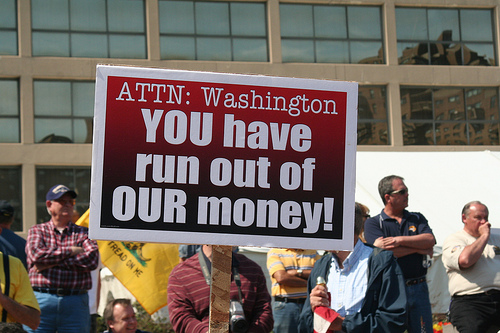
The perception was that tax cuts would pay for themselves and would only work to make everyone wealthier. In the short term they did, but over time they led to the bifurcation of American society. Legislators with the help of lobbyist disproportionately targeted the tax cuts to benefit the top income brackets, and massively so. The socially conservative wing, blinded by its reactionary ideals, got duped. Its followers have effectively voted time and again against their own economic interests.