
Geospatial Politics – A Philosophical Defense

Geopolitical Child Watches The Birth Of The New Human by Salvador Dali. Photo: Gigi Mazzarini/flickr

In a supposedly post-modern world geopolitics can seem passé.  With a dismissive wave of the paw, self-described progressives can (and do) condemn it as a pernicious remnant of a rapidly dying past.  Critics argue, for example, that classical geopolitics has always been suspect as an explanatory device.  It imposes a geographic determinism on international relations that is just too narrow in scope.  And by the way, critics ask, just what do we mean by “geography”?  Even if you believe that geographical factors deserve pride of place in transnational politics, don’t global politics increasingly play themselves out in at least five domains – on land, at sea, in the air, in space and ultimately in the protean world of cyberspace? And don’t the on-going interactions between these domains compound further the fluidity of events and their influences?

Second, critics are right to ask if geopolitics isn’t a self-justifying “language” of empire.  As a mode of political analysis and interpretation, wasn’t it first crafted by those who were prepared to rationalize empire – Friedrich Ratzel, with his not so implicit sympathy for lebensraum, and Halford MacKinder, with his Great Game-tainted focus on the Eurasian World Island?  And what about the prominent 19th century American navalist and geopolitician, Alfred Thayer Mahan; wasn’t there a self-serving circular logic at the core of his beliefs – e.g., large blue-water navies exist for the protection and destruction of foreign-based trade, but trade also seems to exist, at least in Mahan’s universe, to support the existence of battleship-centric navies?  These founding fathers of geopolitics were not only Westerners, but they were also very much creatures of their time – a time of Great Power colonial rivalries where “land grabs” were at the core of international relations. Their version of geopolitics was both an analysis and a justification for Western political behavior.  Where, therefore, is a geopolitics of the developing world, non-Western critics continue to ask.  Is such a construct even possible, or is it a contradiction in terms?
Categories
Humanitarian Issues

The Development Impact of Information and Communication Technologies

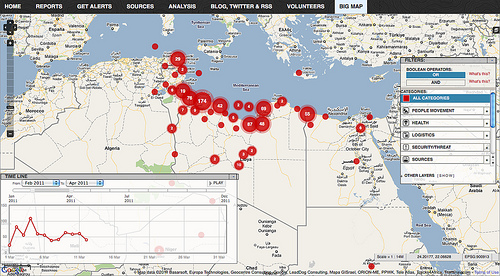
Libya Crisis Map deployed by the Standby Task Force (Standbytaskforce.com) using the Ushahidi platform.

From mobile applications to improve the livelihoods of illiterate farmers to water-management and crisis mapping, the broad spectrum of research and projects presented at the ICT4D – The development impact of information and communication technologies conference on 10 November in Zurich was representative of the wide range of applications and impacts information and communication technologies (ICT) can have in the field of development. Organized by the ETH’s North-South Centre (which has repeatedly focused on the question of how ICT can best serve as a driver for development), the conference highlighted the need for a shift away from a technology-led approach towards one that emphasizes the creative use of already established technologies. Speakers included researchers and practitioners who were not only addressing classical development questions but also shedding light on the political dimensions of the use of ICT.

You’ll find a list of all speakers and their presentations at the end of this blog post. For now, let me pick out a few key themes and challenges that kept recurring throughout the discussion.

Jack Goldstone on Theories of Revolution and the Arab Revolutions of 2011

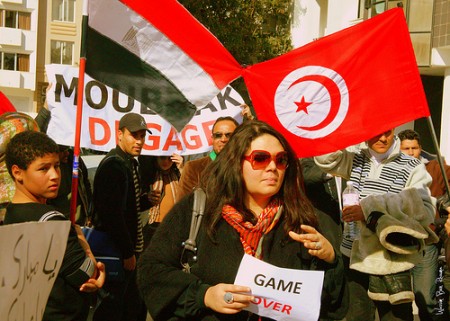
The game is over for Mr Mubarak and Mr Ben Ali. Photo: Wassim Ben Rhouma/flickr
On Thursday 10 November Ralph Stamm and I attended a CIS lecture by Jack A Goldstone, the Virginia E and John T Hazel Jr Professor at the George Mason School of Public Policy. Mr Goldstone has done extensive research on revolutions and social movements and has closely followed the recent uprisings in the Middle East and North Africa, which were at the center of his talk “Not 1848, Not 1989: Theories of Revolution and the Arab Revolutions of 2011.”
As the title suggests, Goldstone’s talk compared the revolutions of 1848, 1989, and 2011. At the outset, he gave his view of the likely outcome of the revolutionary processes in Tunisia and Egypt, both of which he identified as the clearest cases of genuinely revolutionary uprisings in 2011. While initially many people dreamed of creating perfectly functioning democracies and quite a few still fear the rise and dominance of radical Islamist movements, Mr Goldstone expects a middle ground: what he called “troubled democratic outcomes” in both countries.
He then compared the revolutionary periods of 1848 and 1989. In both of these cases, revolutions broke out in several countries in quick succession. While the uprisings were similar in many respects – in terms of mobilization tactics, for example – the outcomes differed. Why was this? Because revolutions never take place in a void: their social, political and economic context matters. In different contexts, we are likely to see different outcomes.

Warfare in the 21st Century – The Advent of (Semi)-Perpetual Peace? (Part 8/8)

Photo: Mikel Daniel/flickr

I closed yesterday’s blog by asking: “So, am I right to assume that Hybrid Warfare is (and will be) the new norm in our back-to-the-future world, or are we slowly but surely vanquishing violence?” The very idea that organized violence and its effects are in irreversible decline is absurd to many a self-proclaimed realist, and for at least three reasons. First, there exists and will always remain the pesky problem of human nature. In other words, Immanuel Kant was right; human beings are indeed “crooked timber.” When you kludge other factors to eternally perverse human nature, to include competition for resources, a structurally defective international system, and inevitable political frictions, the idea that war and its noxious effects are on the wane is seemingly absurd. Indeed, as of the autumn of 2011 weren’t there 18 wars of varying intensity occurring around the globe?

Second, realists tend to dismiss or at least underestimate the evolving power of norms (to include the concept of political legitimacy) and human rights. In their minds, these wispy intangibles are largely fair weather phenomenon. They have not, nor will they ever gain decisive power or influence over time. They represent, in short, superstructural fluff, as Karl Marx might have put it. People honor and practice agreed upon norms and rights when they can, but they invariably jettison them when they must. As a result, norms and rights cannot stand up to the biting winds of war, let alone exercise due influence during periods of genuine crisis.

The Great Paradigm Shift: Denial and then Acceptance II (Part 7/8)

Photo: Sari Dennise/flickr

9-11 introduced a moratorium if not outright end to the intramural squabbling then occurring over the nature and direction of Military Transformation, both in the case of the U.S. Army and Air Force (see yesterday’s blog) and to a lesser degree among NATO allies.  The soon-to-follow second Iraq War, however, showed yet again that old paradigms die hard.  What came to be known as Phase 1 of this war would not have confused Jomini or Clausewitz.  Nor would they have been disoriented by the rationalist (i.e., Jominian) principles behind it either.  It was Phase 2 of the war, of course, that became the problem.  Because the U.S. and its allies remained fixated on long-familiar conventional operations, they were slow to see that three of the supposedly unrepresentative forms of war previously discussed in this series had now actually come to define organized violence.  They were no longer “peripheral”, they were central.  War, that’s capital W war, was different now.  The not-so-stealthy changes that had been knocking on the door for 50 years were now in the house; in fact, they owned the house.  We were now, to use Rupert Smith’s term (see his The Utility of Force: The Art of War in the Modern World), flailing about in “wars amongst the people.”

But what, in practical terms, does this mean?  Well, it means the blurring of what had once been a clear foreign-domestic divide.  It means the blurring of what had been a relatively clear combatant-non-combatant divide.  It means the blurring of what had been war and what had been peace.  (Peace, after all, isn’t necessarily the violated starting point of a conflict.)  It means that organized violence has become privatized and that unregulated “shadow warriors” are now capable of mass effects violence, as only states were once able to do.  And perhaps most importantly, war amongst the people means that J.F.C. Fuller was right.  Total Napoleonic-Industrial Warfare, regardless of all the “bells and whistles” Military Transformation has tried to add on over the last 20-30 years, no longer exists.  There will no longer be “big fights” between multiple nations and their armies à la World War II, or so Smith and his supporters claim.  There will no longer be “massive deciding events” used to resolve international disputes.  Warfare is now “360 degrees”, irregular, asymmetrical, post-heroic, “liquid”, etc.  It focuses on intangibles and not necessarily territory.  It is designed to promote the perceived legitimacy of one collective narrative or storyline at the expense of another.   It stages salutary spectacles to impact the psychology of whole populations.  (The word “stages” is appropriate here since today’s warfare is decidedly theatrical.  It is an updated and more complex version of Prince Kropotkin’s “propaganda by deed.”)