Democracy, Science and Nuclear Reactors in India

Photo: Sakucae/flickr

Speaking at a major event in New Delhi earlier this month, former Prime Minister of Malaysia Mahathir Mohamad alleged that India’s problem is its democracy. The country, he advised, would do better with less rather than more democracy. With hordes of protestors on hunger strike over the construction of India’s newest nuclear reactors at Koodankulam, one might not find it hard to second-guess the source of inspiration behind Dr Mahathir’s astute observation. Democracy, one might argue, has led to policy paralysis in modern India; nothing could be more illustrative of this than the now-rusting steel of Koodankulam. For a country which is the world’s fourth largest consumer of energy and heavily dependent on imports to satisfy its energy demands, nuclear energy seems to be the only way out of the perennial and potentially dangerous problem of energy insecurity.

Built at an exorbitant cost to the Indian exchequer (with help from our all-weather Russian friends), the Koodankulam reactors should already be operational. Instead, the reactors are at the center of controversies concerning safety and environmental issues. The population in the surrounding areas is vehemently boycotting the reactors being brought online, fearing drastic environmental degradation and potential loss of habitat if something goes wrong. While reservations were apparent right from the project’s conception fifteen years ago, the Fukushima nuclear accident has undoubtedly led to an intensification of resistance.

ICC and Ivory Coast: A Step in the Right Direction – If More Are to Follow

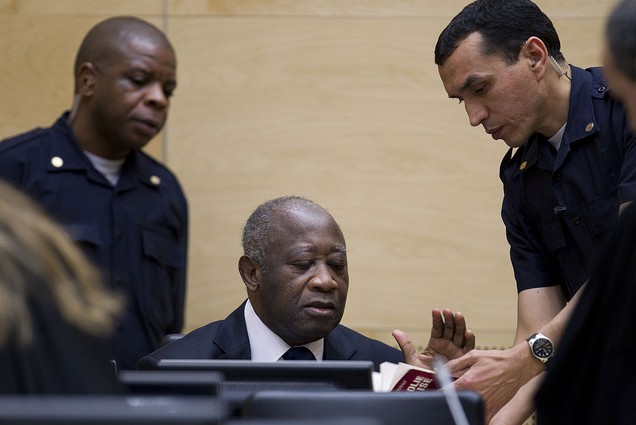
Laurent Koudou Gbagbo in Courtroom I of the International Criminal Court, The Hague, Netherlands, Monday 5 December 2011. © ICC-CPI/AP Photo/Peter Dejong

I wonder how Laurent Gbagbo, sitting in his cell in the International Criminal Court’s (ICC’s) prison in Scheveningen, has reacted to the announcement of the result of Ivory Coast’s legislative elections on 15 December. Alassane Ouattara’s ruling coalition won an overwhelming majority in the national assembly – nearly 220 out of a total of 254 seats. These elections followed a period of violent upheaval in response to the disputed presidential elections of October 2010. They were, however, marked by low voter turnout (36.6%) and a boycott by the opposition.

But while Gbagbo may be satisfied with the effectiveness of the electoral boycott, he nevertheless ceases to have any direct influence within the political system of Ivory Coast. Instead, he can call himself the first former head of state to stand trial at the ICC. Gbagbo’s arrest warrant lists four charges of crimes against humanity, alleged to have occurred between 16 December 2010 and 12 April 2011.

The new chief prosecutor confirmed that the ICC became active in this case upon the request of the Ouattara government. Prior to the legislative elections Gbagbo was moved from house
arrest in the Ivory Coast to The Hague. The move reflects Gbagbo’s convictions that as long as he was still in the country, Ouattara would not be able to govern. Thus, said one of his defense lawyers in an interview, Gbagbo considered the indictment as politically motivated.

Being Italian and a Woman These Days

Photo: Associazione Orlando/flickr

Italy is one of those countries where a lot of wild contradictions regarding gender, misfortune, and economic circumstance can occur simultaneously. Take the word “mignotta,” which is Roman dialect for “whore,” “bitch,” or “slut”—when referring to a woman. Or a gay man. Or a transsexual man. Or, for that matter, simply an untidy woman. But which originally, back in the Middle Ages, was an acronym referring to an abandoned child whose mother was unknown to the local authorities.

Nothing since that time has changed much in Italy, a country where it is still (a) not a good idea to be a woman, if you can possibly avoid it, and (b) a great place to be a woman, but only under special circumstances. Such as if you’re extremely beautiful, very young, and never met former Prime Minister Silvio Berlusconi.

Categories
Uncategorized

Evolving Ideas of Nationalism II

Travelling the world - but only with states

This week the ISN will examine the role of nationalism in an evolving and dynamic international system. We will also consider whether multiculturalism is a necessary and appropriate response to some of the more retrograde and unsettling aspects of nationalism. From the outset, however, it is important to mention that the social science literature on nationalism often emphasizes 1) the lack of a comprehensive definition for the term, or 2) that there is a multiplicity of nationalisms. Indeed, these nationalisms often get defined with catch-all terms such as New Nationalism, Liberal Nationalism, Small Nationalism and so on. This multiplicity, in turn, confirms that the very concept of the nation has developed across the course of history and refers to more than just to a group of people born in the same place.

Again, to chart our understanding of nationalism today, we begin by quickly outlining Ernst Renan’s conception of the nation-state, followed by a look at how some analysts are trying to transform this traditional view of it in order to respond more effectively to the stresses of globalization. (Yes, nationalism provides states with a cohesive identity, but often by playing upon the insecurity of societies to achieve desired outcomes.) Finally, we will quickly look at multiculturalism and see whether it offers an approach to addressing global challenges that is more user-friendly than nationalism.

Categories
Uncategorized

The Future of Nationalism and the State – Introduction

'Liberty Leading the People' by Eugène Delacroix. Image: Wikimedia Commons

Thus far in our Editorial Plan we have posited a simple overarching theme – the international system is indeed undergoing irrevocable and tectonic changes. To illustrate this claim, we have done three things thus far. First, we asked ourselves what the trajectory of these changes might look like. We looked, in other words, at the challenges and opportunities afforded by international relations-centered future forecasting. Second, we built on this exercise in ‘futurology’ to look at the traditional geopolitical dimensions of international relations today and tomorrow. Last, we then looked at geopolitics’ theoretical opposite – i.e., we looked at the arguments presented by those who would have us pursue global interdependence and effective multilateralism rather than hew to traditional geopolitical lines.

This week and then starting again on January 2 (yes, we will feature new material during Christmas week, but it won’t be part of the Editorial Plan), we will ‘sandwich’ our previous analysis of global interdependence between our initial discussion of geopolitics and our current discussion of nationalism and the state. Over the years we have tended to hyphenate these two categories, but we know better now. Nationalism is a broader concept and carries with it considerable socio-cultural ‘baggage.’ We therefore plan to look at it first this week and pit it against a rival concept that has equally vociferous advocates – multiculturalism. Then, after the Christmas break, we will resume our discussion by looking at the state of the state in international relations. By twining our analyses of nationalism and the state in this way, we will have addressed the geopolitics of international relations, its potential for interdependence and multilateral cooperation, and its still-dominant Westphalian dynamics. As usual, we wish you happy reading.