Categories
Uncategorized

The Anarchy Factor in Syria

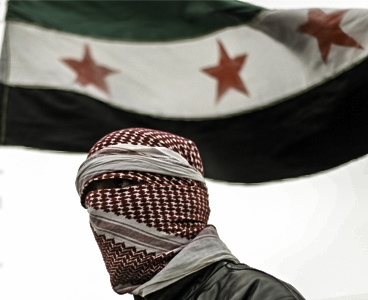
Syria Independence Flag behind a Free Syrian Army member
Syria Independence Flag behind a Free Syrian Army member (Photo: Freedomhouse2/flickr)

TEL AVIV – The failure of the Obama administration, its Western allies, and several Middle East regional powers to take bolder action to stop the carnage in Syria is often explained by their fear of anarchy. Given the Syrian opposition’s manifest ineffectiveness and disunity, so the argument goes, President Bashar al-Assad’s fall, when it finally comes, will incite civil war, massacres, and chaos, which is likely to spill over Syria’s borders, further destabilizing weak neighbors like Iraq and Lebanon, and leading, perhaps, to a regional crisis.

What is actually happening in Syria refutes this argument. In fact, the lingering crisis is corroding the fabric of Syrian society and government. Anarchy is setting in now: it is preceding – and precipitating – the regime’s eventual fall.

The United States and others are substituting high rhetoric and symbolic punitive action for real action on Syria. Sanctions on those involved in electronic warfare against the opposition’s social media are not the answer to the shelling of civilian neighborhoods in Homs and Deraa.

Missing Pieces: China’s Challenges, Africa’s Mixed Picture, and More

By Isobel Coleman for Council on Foreign Relations.


An employee puts up a price tag after updating the price at a supermarket in Hefei, China, April 9, 2012 (Jianan Yu/Courtesy Reuters).

In this week’s installment of Missing Pieces, Charles Landow discusses stories on China and Africa, as well as a report on U.S. international engagement. Enjoy the reading.

Giving the Well-Performing State Its Due

Is the capitalist system doomed? (Photo: Sterneck/flickr)

MADRID – The triumph of democracy and market-based economics – the “End of History,” as the American political philosopher Francis Fukuyama famously called it – which was proclaimed to be inevitable with the fall of the Berlin Wall, soon proved to be little more than a mirage. However, following China’s intellectual pirouette to maintain one-party rule while embracing the capitalist credo, history’s interpreters shifted their focus to the economy: not everybody would be free and elect their government, but capitalist prosperity would hold sway worldwide.

Now, however, the economic tumult shaking Europe, the erosion of the middle class in the West, and the growing social inequalities worldwide are undermining capitalism’s claim to universal triumph. Hard questions are being asked: Is capitalism as we know it doomed? Is the market no longer able to generate prosperity? Is China’s brand of state capitalism an alternative and potentially victorious paradigm?

Categories
Uncategorized

Is Georgian ‘Modernisation’ Leading the Country to Serfdom?

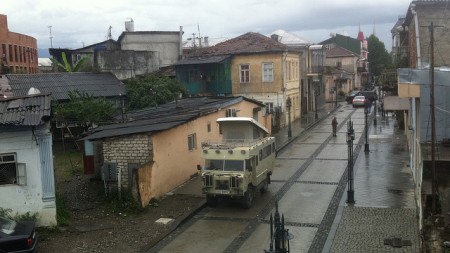
Security personnel on a street in Batumi, Georgia. Image by sugarmelon.com/Flickr.

Ever since the so-called Rose Revolution of 2003, the Georgain administration has been heralded as the leading reformer in the region. Presiding over a state of constant change, it has managed to convince large parts of both domestic opinion and the international community that it alone is the guarantor of modernisation and development.

Clearly, the unprecedented increase in international financial assistance has allowed Georgia’s administration to launch large-scale projects and develop the country’s institutions and infrastructure. But have modernising reforms masked the fact that the government has ridden roughshod over democratic values? Over the years, I argue, the answer to this question has been a fairly unambiguous ‘Yes’.

Categories
Uncategorized

Russia is Striving to Implement its Model for the Resolution of the Transnistrian Conflict

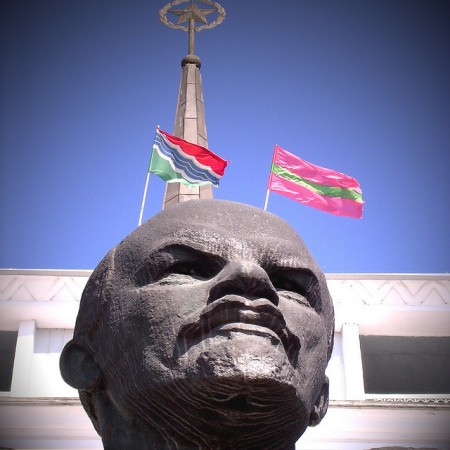
Lenin with flags - Transnistria. Image by tetteroomedia/Flickr.

Two unprecedented visits by Russian senior state officials have been made over the past few weeks in Tiraspol. On 12 April, Transnistria was visited by Defence Minister Anatoliy Serdyukov, and on 16–17 April by the deputy prime minister and special presidential envoy, Dmitry Rogozin.

In turn, on 18 April in Vienna, in the framework of the international negotiating format for the Transnstrian conflict, two documents were signed, which defined the principles and the agenda for substantive negotiations (the 5+2 format includes Chisinau and Tiraspol as parties to the conflict, Russia, Ukraine and the OSCE as the mediators and – since 2005 – the European Union and the United States as observers).