
Stormy Waters? The Maritime Border Disputes between Bolivia, Chile and Peru

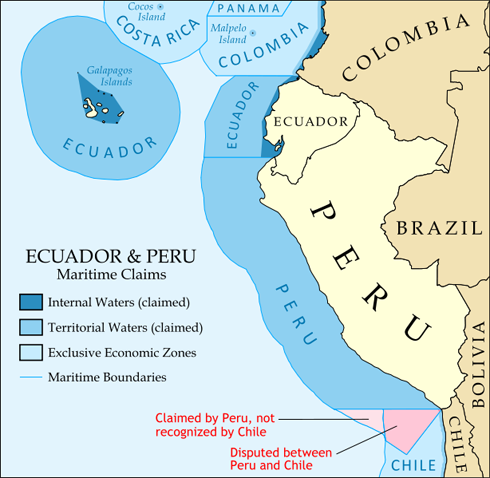
Map of the maritime claims of Ecuador, Peru, and surrounding countries. Source: Political Geography Now via Wikimedia Commons

International boundaries are often blurred by the processes of globalization, but in South America some maritime borders remain contested. For instance, Chile and Peru, neighbors that have enjoyed sustained economic development over the past few years, remain at odds over approximately 38,000 square kilometers of sea located along their maritime border.

Bilateral negotiations between the two countries were first held in 1980 but no agreement was reached. In 2008, Peru took the case to the International Court of Justice (ICJ) which, in turn, considered the issue at a public hearing in December 2012. The ICJ is expected to make a ruling on the dispute in mid-2013.

In the meantime, Peru continues to argue that the maritime border has not yet been defined by any agreement, with documents signed in the 1950s only relating to access to fishing grounds.  Lima also claims that maritime limits should run diagonally south-west from the land border.
المياه العاصفة؟ النزاع على الحدود البحرية بين بوليفيا، شيلي، وبيرو

Map of the maritime claims of Ecuador, Peru, and surrounding countries. Source: Political Geography Now via Wikimedia Commons

عادة ما تكون الحدود الدولية غير واضحة بموجب عمليات العولمة، لكن في أمريكا الجنوبية لا يزال هناك نزاع على الحدود البحرية. على سبيل المثال، شيلي وبيرو، جارتان يتمتعان بتنمية اقتصادية مستدامة على مدار السنوات القليلة الماضية، لا يزالان يتنازعان [بالعربية] على ما يقرب من 38,000 كيلو متر مربع من المياه الواقعة على طول حدودهما البحرية.[جميع الروابط بالإنجليزية والإسبانية ما لم يذكر غير ذلك]

بدأت المفاوضات الثنائية بين البلدين عام 1980 دون التوصل لاتفاق. في عام 2008، قدمت بيرو القضية إلى محكمة العدل الدولية [بالعربية] التي بدورها، درست القضية أمام لجنة استماع عامة في ديسمبر/ كانون الأول 2012. ومن المتوقع أن تعلن المحكمة الحكم في هذا النزاع منتصف العام الجاري 2013.

¿Aguas tormentosas? La disputa por la frontera marítima entre Bolivia, Chile y Perú

Map of the maritime claims of Ecuador, Peru, and surrounding countries. Source: Political Geography Now via Wikimedia Commons

Las fronteras internacionales son a menudo borradas por los procesos de globalización, pero en América del Sur algunas fronteras marítimas siguen siendo impugnadas. Por ejemplo, Chile y Perú, los vecinos que han disfrutado de un desarrollo económico sostenido durante los últimos años, siguen en desacuerdo sobre unos 38.000 kilómetros cuadrados de mar situados a lo largo de su frontera marítima.

Las negociaciones bilaterales entre los dos países se realizaron por primera vez en 1980, pero no se llegó a un acuerdo. En 2008, el Perú llevó el caso a la Corte Internacional de Justicia (CIJ) [en], la que, a su vez, consideró la cuestión en una audiencia pública en diciembre de 2012. Se espera que la CIJ emita un fallo sobre la disputa a mediados de 2013.

Chili, Pérou et Bolivie en eaux agitées : les frontières maritimes, sujets de discorde

Map of the maritime claims of Ecuador, Peru, and surrounding countries. Source: Political Geography Now via Wikimedia Commons

Les frontières internationales sont souvent brouillées par la mondialisation et, en Amérique latine, les frontières maritimes sont toujours matière à contestations. Deux pays frontaliers, le Chili et le Pérou par exemple, qui ont pourtant joui d’un développement économique soutenu au cours des dernières années, demeurent en désaccord sur leurs frontières maritimes respectives, un contentieux qui concerne une superficie maritime d’environ 38 000 mètre carré.

En 1980, des négociations bilatérales entre les deux pays ont été tenues, pour la première fois, mais n’ont abouti à aucun accord. En 2008, le Pérou a porté le litige devant la Cour Internationale de Justice (CIJ), qui, à son tour, a examiné la question lors d’une audience publique en décembre 2012. La CIJ devrait rendre sa décision à la mi-2013.

Pendant ce temps, le Pérou n’a eu de cesse d’affirmer que les frontières maritimes n’avaient jamais été l’objet d’un accord qui les définissait et les seuls documents à ce sujet, signés en 1950, ne font que règlementer l’accès aux zones de pêche. En outre, Lima a également déclaré que les frontières maritimes devaient être délimitées par une diagonale qui, partant de la frontière terrestre du Pérou, se dirigerait vers le large, direction Sud-Ouest.

Iran in 2013: the Year of Not Living so Dangerously?

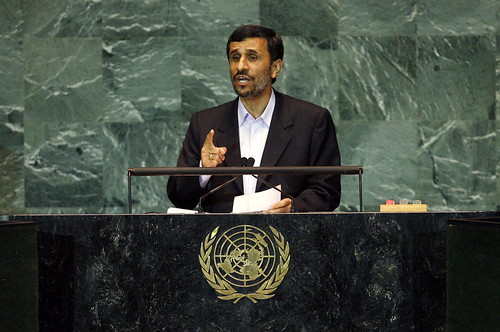
President of Iran Addresses General Assembly
President of Iran addresses UNGA. Photo: United Nations Photo/flickr.

Despite eight months of negotiations with the E3+3, Iran remains committed to its highly-controversial nuclear program. Talks over the past year followed a similar pattern to previous discussions, with the E3+3 failing in its attempts to establish the true nature of Tehran’s ambitions. Negotiations were also conducted against the backdrop of growing political unrest across the Middle East and the prospect of an Israeli attack on Iranian nuclear facilities. Yet despite continued frustration and the growing threat of conflict, 2013 might turn out to be the year in which negotiations take a turn for the better.

In terms of improving dialogue with the International Atomic Energy Agency (IAEA), Iran appears determined to pick up where it left off in December 2012. Despite failing to agree upon a framework for the future inspection of Iranian nuclear facilities, both sides will resume talks on February 12th. Back in August, the IAEA also reported that Iran’s stockpile of 20% enriched uranium had remained unchanged since May, when Tehran converted supplies for medical purposes.

Another source of inspiration may come from the re-election of Barack Obama. In remarks made shortly after his victory, the U.S. President reiterated the importance of negotiating with Iran. Along with promises to push for the resumption of direct dialogue with Tehran, Obama also openly suggested that Iran might be able to maintain a low-scale nuclear program on condition that it provides credible evidence that it is being used for peaceful purposes.