
Categories
Terrorism Regional Stability

Plans to Retake Mosul from ISIS Reveal There’s More at Stake than a City

Two Iraqi armed insurgents, courtesy Menendj/WikiMediaCommons

This article was originally published by the IPI Global Observatory on 11 March 2016.

It seems clear that pro-government forces in Iraq are preparing to retake Mosul, Iraq’s second largest city. The Islamic State (ISIS), a Sunni extremist group, captured Mosul following a series of assaults in June 2014, an offensive that ultimately resulted in an embarrassing collapse of the Iraqi Army in northern Iraq. Since then, the Iraqi government has made the recapture of Mosul a key domestic goal in its fight to reclaim its territory and reassert its control over a restive minority Sunni population. Prior to the events of 2014, the Sunnis were agitating for greater regional autonomy, akin to the political status of the Iraqi Kurdistan Regional Government (KRG), and strongly against the Shiite-dominated central government.

Mosul lies at a strategic juncture between a number of groups, including the Turks, Kurds, Arab Sunnis and Persian Shiites. It is also lies in close proximity to several states and territories, including Iraq, Iran, Turkey, Syria, and the autonomous northern KRG. Which party controls this city is a significant determinant for all of these regional powers when considering their border security and foreign policy.

Interview – J. Ann Tickner

Hillary Clinton and Michelle Obama with the 2012 IWOC Award Winners, Courtesy US Department of State/WikimediaCommons

This interview was originally published by E-International Relations on 6 March 2016.

J. Ann Tickner is Distinguished Scholar in Residence at the American University. She is also a Professor Emerita at the University of Southern California where she taught for fifteen years before coming to American University. Her principle areas of teaching and research include international theory, peace and security, and feminist approaches to international relations. She served as President of the International Studies Association from 2006-2007. Her books include, A Feminist Voyage Through International Relations (Oxford University Press, 2014), Gendering World Politics: Issues and Approaches in the Post-Cold War Era (Columbia University Press, 2001), Gender in International Relations: Feminist Perspectives on Achieving International Security (Columbia University Press, 1992), and Self-Reliance Versus Power Politics: American and Indian Experiences in Building Nation-States (Columbia University Press, 1987).

Where do you see the most exciting research and debates happening in your field?

I think the most exciting research is being done at the margins by scholars who are pushing the disciplinary boundaries of what we think of as IR into areas such as historical sociology, post-colonialism, race and gender. Although the mainstream US discipline is still quite hegemonic, I believe this hegemony is somewhat on the decline and there is more space for critical perspectives.

There are good revisionist histories that tell non-conventional stories about the origins of the discipline. And there is a great deal of exciting critical work being done by scholars in other parts of the world that attempts to construct an IR that reaches beyond geographical and disciplinary boundaries. The Worlding Beyond the West series edited by Ole Waever and Arlene Tickner and by Tickner and David Blaney is a good example. Other examples are recent work on race, empire and gender. It is quite astonishing how IR has erased imperialism and the anti-colonial struggles of the twentieth century from its historical memory. These are issues that are fueling so many of today’s conflicts.

The Question of Women’s Roles in Conflict

Female Afghan National Police officers, courtesy NATO Training Mission-Afghanistan/flickr

This article was originally published by openDemocracy on 15 February 2016.

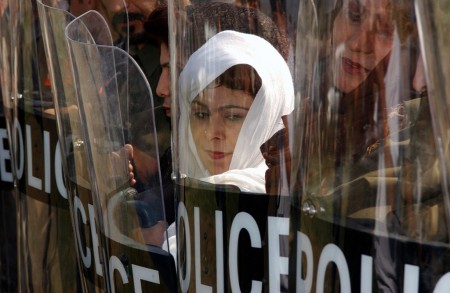
The U.S. Department of Defense has paid scant attention to the roles local women play in conflicts, either as aggressors, crucial fighting support, or powerful peace builders – to the detriment of global security.

Now that the U.S. Department of Defense (DoD) has opened all military occupations to women in order to take advantage of the skills and perspectives they have to offer, perhaps this move will help it to overcome a bias that continues to handicap its operations: its lack of recognition of the critical contributions of local women in conflict areas. To date, multiple opportunities to defeat insurgents, stabilize communities and promote peace in Iraq, Afghanistan, Syria, and many other countries have been squandered because of the military’s almost exclusive focus on the male half of populations.

As a result of this persistent exclusion in zones of conflict, commanders are effectively precluding themselves from taking advantage of all opportunities to defeat armed groups, mitigate the influence of malign forces, and facilitate peace and stability. Paradoxically, this obliviousness also directly contradicts military leaders’ contemporary emphasis on obtaining in-depth “situational awareness” in order to effectively deal with conflict.

Categories
Terrorism

This is Your Jihad on Drugs

Cache of weapons and drugs in Daykundi province, courtesy ResoluteSupportMedia/flickr

This article was originally published by War on the Rocks on 7 March 2016.

Santa Claus is commonly imagined as a jolly, benevolent figure who delivers presents to deserving children all over the world. However, another version of Santa Claus exists in the organized crime underworld of Belgium where a Moroccan named Khalid Zerkani is commonly known as “Papa Noel.” Before his arrest, Zerkani would routinely handout money and presents to at-risk youth in the Molenbeek neighborhood of Brussels, luring them into his organization. Unlike ordinary organized crime groups that engage in illegal activities for personal enrichment, Zerkani’s group used its criminal proceeds to finance trips of recruits from Europe to join the Islamic State of Iraq and the Levant (ISIL). One notorious recruit of Zerkani’s was Abdelhamid Abaaoud — the ringleader of the Paris terrorist attacks.

The link between crime, radicalism, and ISIL has only recently come into greater focus. Oil smuggling, extortion, and sex trafficking in ISIL-controlled territory are well-known, yet other crimes like drug production, trafficking, and consumption are not. It is important to better understand drug use and the drugs trade because both are helping ISIL commit atrocities and wage its campaign of terror. Viewing ISIL and other jihadist groups as mere collections of drug-crazed fanatics, however, would be a caricature. Organizations like ISIL use drugs for tactical, operational, and strategic reasons that are historically consistent with the behavior of other violent groups in the past. It is worth considering drug consumption within ISIL and other jihadist groups as we consider how to fight them.

A Ripe Moment for Change at the UN?

UNSC Chamber in New York, the Norwegian Room, courtesy Patrick Gruban/WikiMedia

This article was originally published by the IPI Global Observatory on 9 March 2016.

The United Nations was created to foster peace and stability among nations and promote economic prosperity and social justice for all. Seventy years later, there is a shared sense that the global structures[1] entrusted with peace and security are not keeping pace with today’s more complex and interconnected world, where local problems have global dimensions and where the monopoly of violence is no longer the sole preserve of states—a world where the nature of peace and conflict is challenging the analytical frameworks, norms, and paradigms that have been painstakingly fashioned over the past two decades.

The three major peace and security reviews conducted in 2015[2] have taken stock of the changing global environment; analyzed UN responses; and come up with several key policy messages, as well as a number of complementary recommendations which, if implemented, could help the UN peace and security architecture be better fit for purpose.