South Sudan celebrated its third year of independence on July 9, 2014. The United Nations Mission in the Republic of South Sudan (UNMISS) also marks its third year of operation. Designed to complement southern independence, UNMISS was tasked by the Security Council (UNSC) to consolidate peace and security in a country devastated by decades of war. UNMISS was formed under a mandate logic of peace consolidation through statebuilding; an ambitious agenda in a territory which had barely been touched by administration, and where formal institutions were the exception. Amidst widespread poverty and illiteracy, achieving independence was the first step for South Sudanese toward the realization of equal rights and the opportunity for self-governance, signaling for many an opportunity for stability and economic growth.
As the centenary of the outbreak of the First World War draws closer, it must be remarked that the most significant change to the geopolitical map since 1914 was not the defeat of fascism, nor the death of Soviet-style communism, but the complete collapse of all the European imperialist systems of government. Of course, various forms of hegemony, colonialism, and suzerainty still exist in the modern world and European nations have not been above overseas conflict since the end of the Cold War. However, a century after the start of Europe’s bloodbath the continent, now at peace, has turned inwards in its thinking.
Steven Pinker, one of the world’s leading academics in peace and conflict studies, provides a sweeping summary of the history of violence and conflict since 10,000BCE in his book ‘The Better Angels of Our Nature’. Using a wide array of case studies, historical evidence and statistics, Pinker concludes that, contrary to popular perceptions, since the dawn of civilization the world has become increasingly less violent.
For instance, the research of Manuel Eisner suggests that during the Middle Ages the rate of homicides in Europe lay somewhere between 20 to 40 per 100,000 persons, while in modern times estimates place the rate closer to 1 per 100,000. Similarly, we know that deaths relating to war have been trending downwards since 1946 as a consequence of a reduction in interstate and international armed conflict.
The Commons Lab, an initiative of the Woodrow Wilson International Center for Scholars recently published a provocative article entitled “ New Terrorism and New Media.” In his discussion, Professor Gabriel Weimann of Haifa University in Israel focuses on insurgent movements such as Al-Qaeda and its affiliates. His work explains how terrorist movements utilize social media outlets, such as YouTube, Twitter, Facebook, and Instagram, to expand the reach of their ideology and attract new converts.
According to Weimann, social media is different than traditional internet resources because, with social media, terrorists are able to directly target individual followers. Thus, social media has increased the number of “lone wolf terrorists,” namely individuals who commit terrorist acts without being connected to a particular terrorist organization. With the rise of social media, Weimann argues that the war on terror has become increasingly “vital, dynamic, and ferocious,” and creates a new front in the struggle for international security.
However, the use of social media and new technology is not limited to violent groups in the Greater Middle East. Thus, the authors of this article would like to expand upon Weimann’s research by discussing how criminal groups in Latin America have also been successful at utilizing new media resources.
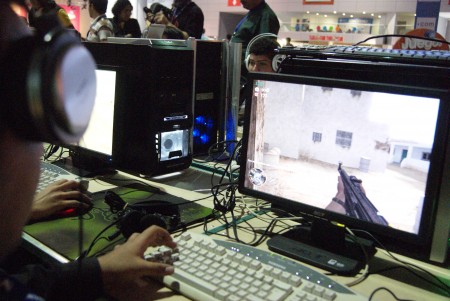
Online Game Call of Duty, courtesy of Movistar Campus Party México
This article was originally published by Strife on 12 June 2014.
Storytelling is a core part of how we communicate with each other, understand complex issues and come to terms with the world around us. The prevalence of so-called ‘talking therapies’ show that such processes are important in helping to overcome and move past negative events and experiences. The experience of 9/11 left long-lasting and deep collective and cultural damage on the US/Western collective psyches. The ‘War on Terror’ has been compared to what Vietnam was for Lyndon Johnson: ‘a vast, tragic distraction in which he must be seen to be winning, lest the domestic agenda he really cares about be derailed.’ Popular culture, in this case Western-developed video/computer games, have become a medium in which the cathartic and curative process of storytelling is taking place on a cultural level, to move past and overcome both of these ‘unfinished’ conflicts.
War and conflict have been staple thematic topics in games for decades, as far back as Space Invaders and Missile Command in the late 1970s. However, the games released after 9/11 show an interesting pattern indicating a marked swing in direction and focus. Between 2002 and 2005 there were two games released that were set during the first Gulf War (Conflict: Desert Storm I & II), at least nine games released set during the Vietnam War (Vietcong, Vietcong 2, Battlefield: Vietnam, Conflict: Vietnam, Shellshock: ‘Nam 67, Wings over Vietnam, Platoon, Men of Valor, Line of Sight: Vietnam) as well as many more set in the modern day in real or analogous Middle-Eastern theatres. One of the most stand-out titles from this period was America’s 10 Most Wanted, whose finale consists of the player fighting Osama Bin Laden in hand-to-hand combat, and subsequently bundling him into a helicopter that flies off into the sunset while the credits roll. From this period mainstream game development began to shift to reflect changing current events. From 2008 games in this thematic field have often adopted Private Military Contractors in both pro and antagonistic roles. after the details of Blackwater’s/Xe’s involvement in Iraq became wider public knowledge and a hot topic of the time.
The ability of popular culture to serve as a space for cultural catharsis and as a coping mechanism isn’t a new one; after the collective cultural trauma of Vietnam a similar process of mourning and understanding took place. The trajectory of tone and content in the ‘war is hell’ films from the 1970s such as Apocalypse Now and The Deer Hunter shifted dramatically to the restorative and cathartic films from the 1980s like Top Gun and Rambo. These films either painted the US military in a far more positive and victorious light or, in the case of Rambo, literally re-fighting Vietnam on-screen.