Categories
Global Voices

Myanmar: Monitoring the Elections Through Facebook

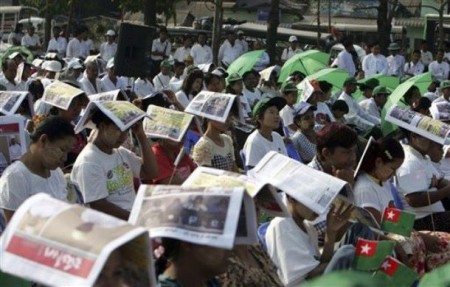
Election campaign by the Union Solidarity and Development Party (USDP). Image by Demo Waiyan/Facebook.

Myanmar has been implementing a lot of reforms in the past years which included the release from prison of democracy icon Aung San Suu Kyi, the suspension of a controversial dam project and the unprecedented release of hundreds of political prisoners. And now, it’s time for by-elections.

Two major parties, namely National League for Democracy (NLD), which is led by Aung San Suu Kyi and Union Solidarity and Development Party (USDP) dominated by former military generals are competing for all 45 places in parliament while some other parties such as The Democratic Party, New National Democracy Party (NDP), National Unity Party (NUP) and so on are competing for fewer places.

Myanmar Facebook users are overwhelmed with different news regarding the election which is coincidentally on April Fools’ Day.

Where Does Russia’s Opposition Go From Here?

Anti-Putin rally in Moscow on 4 February 2012. Image: Wikimedia Commons (Leonid Faerberg)
The crowds are dwindling at the protest rallies, the energy seems to be draining away.

There are several problems for Russia’s opposition movement. The first is that Vladimir Putin’s crushing victory in the presidential elections – no matter how flawed – has changed the equation in Russia, and the opposition is struggling to adapt to this new reality. Some opposition groups believe that even without any cheating on election day, Putin would have got just over 50 per cent of the vote, and thus won in the first round, (although these groups would also argue that the electoral campaign as a whole was not fair, and that Putin’s return to the Kremlin is a violation of the spirit, if not the letter, of the constitution). Nonetheless, the reality is that  Putin is back, with a six year term, and this drains the morale of the opposition.

Are Domestic Factors Relevant in Deciding to Join a Military Coalition?

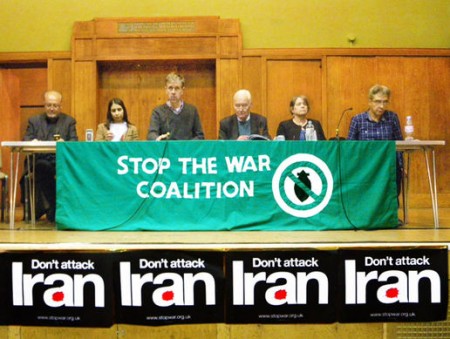
‘Stop the War Coalition’ event against a military assault in Iran by the US, UK and Israel. Image: moblog.net

Atsushi Tago claims that they are. His presentation at the CIS Colloquium series on Thursday (March 15, 2012) aimed to challenge mainstream opinion – including the results of his own previous research – and prove that, apart from solely international factors, domestic factors also matter in explaining why a country chooses to join an ad-hoc military coalition. With the quantitative analysis he presented, he was trying to validate a particular hypothesis: that in an election year, in an economic recession, or in period of domestic riots, a country is less likely to join a military coalition. In view of the upcoming elections in Israel and the US, Tago’s research could be of considerable interest for professionals and academics working with the Iranian nuclear issue.

Tago’s logic is threefold: first, he claims that the true benefits (or detriments) of joining a coalition force are often hidden from the electorate. Therefore, in an election year, governments will be reluctant to participate in armed coalitions for fear that the people will voice their disapproval at the ballot.

A Specter is Haunting Western Policy-Makers

Photo: Steve Paulo/flickr

Much to the chagrin of Western governments, Egypt’s first elections since the overthrow of Mubarak’s regime in February are unlikely to yield a secular democratic government. Receiving an estimated 65 percent of total votes, Islamist parties consolidated their gains in Egypt’s second round of multistage parliamentary elections held on December 14-15, achieving yet another landslide victory that is unlikely to be reversed in the third and last round of voting in January. Although not fully surprising, the marginalization of liberal and secular forces at the ballots has caused notable uncertainty among Western states when it comes to formulating foreign policy options towards Egypt and the Middle East more generally.

Governments in both Europe and the US have been understandably reluctant to voice premature concessions in the face of a probable coalition government dominated by Islamist parties. To be sure, even though the Muslim Brotherhood and the Al-Nour Party, the political wing of the Salafi movement, do not share a fully congruent ideology, they are both in favor of implementing Sharia law. The dilemma is obvious even despite the political outcome in Egypt. What remains is great ambiguity in how political Islam would actually be implemented once the relevant factions seize power, and whether this would be compatible with the stipulations the revolution has fought for and, moreover, Western ideals of self-determination and human rights.

ICC and Ivory Coast: A Step in the Right Direction – If More Are to Follow

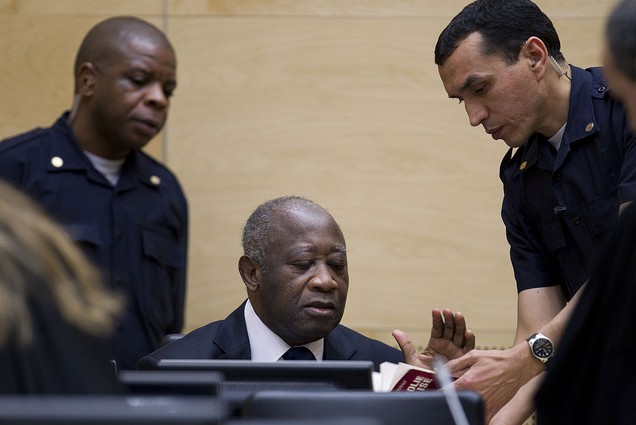
Laurent Koudou Gbagbo in Courtroom I of the International Criminal Court, The Hague, Netherlands, Monday 5 December 2011. © ICC-CPI/AP Photo/Peter Dejong

I wonder how Laurent Gbagbo, sitting in his cell in the International Criminal Court’s (ICC’s) prison in Scheveningen, has reacted to the announcement of the result of Ivory Coast’s legislative elections on 15 December. Alassane Ouattara’s ruling coalition won an overwhelming majority in the national assembly – nearly 220 out of a total of 254 seats. These elections followed a period of violent upheaval in response to the disputed presidential elections of October 2010. They were, however, marked by low voter turnout (36.6%) and a boycott by the opposition.

But while Gbagbo may be satisfied with the effectiveness of the electoral boycott, he nevertheless ceases to have any direct influence within the political system of Ivory Coast. Instead, he can call himself the first former head of state to stand trial at the ICC. Gbagbo’s arrest warrant lists four charges of crimes against humanity, alleged to have occurred between 16 December 2010 and 12 April 2011.

The new chief prosecutor confirmed that the ICC became active in this case upon the request of the Ouattara government. Prior to the legislative elections Gbagbo was moved from house
arrest in the Ivory Coast to The Hague. The move reflects Gbagbo’s convictions that as long as he was still in the country, Ouattara would not be able to govern. Thus, said one of his defense lawyers in an interview, Gbagbo considered the indictment as politically motivated.