The Consequences of German Decisions

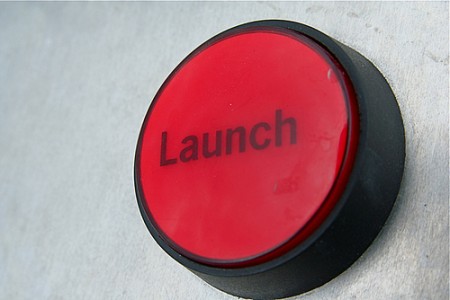
Small button, big consequences / Photo: Steven De Polo, flickr

After the German-directed ISAF air strike on two fuel vehicles stolen by the Taliban reportedly cost civilian lives, public calls for clarification are accompanied by both palsy and hectic in Berlin. Federal elections will take place in less than 3 weeks.

What often happens when things go very wrong is that people engage in speculation and search for a scapegoat. Too seldom though, we see people take responsibility, especially in politics. Clausewitz wrote that war never is an end in itself and always serves a political purpose. Imagine now a trigger in the hands of a German soldier serving in an army with a heavy legacy; an army from a pacifistic, self-traumatized post-war state, in which military planning, strategy and even tactics are subject to widespread emotional discussions. How much politics can efficient tactics bear?

Categories
Uncategorized

Politics in Motion

ISN Booth
ISN Booth

Greetings from the annual meeting of the American Political Science Association in Toronto.

In the first time in its 104 years, the meeting takes place outside the US. According to the organizers, this traveling across a border is symbolic for the conference theme “Politics in Motion: Change and Complexity in the Contemporary Era”. The event, consisting of hundreds of panels and an exhibition, looks at what is new, different and unusual in politics today and aims to think about what knowledge is needed to deal with change and complexity and address today’s crucial challenges.

Emotions and Politics

Looking for the unusual in the thick conference program, I attended a panel on neuropsychology and international politics. The panel converged two fields that have been unconnected previously: brain science and international politics.
The presenters advocated the consideration of emotions when studying political decision making. Evidence shows that cognition (thinking) is actually preceded by emotions (feelings). Hence, “rational” decisions are taken on the basis of emotional beliefs. According to the panelists, it is, however, still unknown how cognition and emotions work together in different situations.

What do these findings in brain science mean for political science and international affairs?

Categories
Uncategorized

Iran: Options for the West

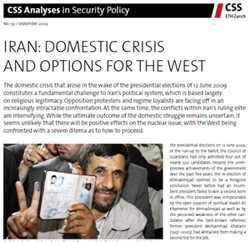
Iran: Domestic Crisis and Options for the West

What are the effects of Iran’s domestic crisis on the nuclear issue?

A new analysis by the Center for Security Studies (CSS) looks at policy options available for western governments.

Roland Popp, senior researcher at the CSS, argues that the weakening of the Iranian regime is unlikely to ease negotiations with Tehran over the nuclear issue.

You can download the paper here.

This Is for the Mara Salvatrucha

This Is For The Mara Salvatrucha, by Samuel Logan

ISN Security Watch correspondent Samuel Logan has just released his first book, “This is for the Mara Salvatrucha” (Hyperion Books), a non-fiction narrative about Brenda Paz and her last three years of life.

Paz was a young member of the Mara Salvatrucha, or MS-13, who became a federal informant before she was killed after running away from witness protection.

“This is for the Mara Salvatrucha” uncovers little-known truths about the MS-13, one of America’s most violent street gangs, and reveals how the street life can be alluring. It also takes a close look at the the realities of living inside the US as part of a Latino immigrant community, underscoring the challenges with policing these communities and the fluidity of illegal movement across the US-Mexico border.

The book has been optioned by Paramount Vantage Films.

More of Sam’s extensive work about the MS-13 in ISN Security Watch:

Tri-state trouble with Mara Salvatrucha

Mexico’s Parallel Power

Prison Gangs and Organized Crime

ISN Weekly Theme: Japan Changes

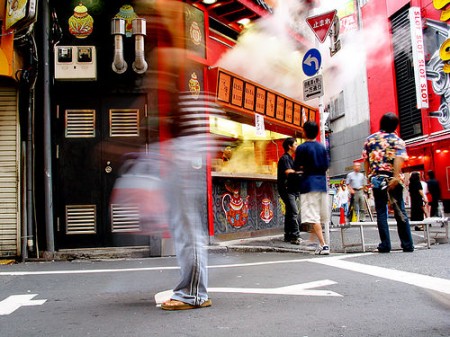
Street scene in Tokyo/Photo: James D Law
Street scene in Tokyo/Photo: James D Law, flickr

As Europeans celebrate the 20th anniversary of the fall of the Berlin Wall, in Japan, the Cold War political system has just been overthrown. The Liberal Democratic Party (LDP), which together with the bureaucracy and big business formed the clichéd ‘iron triangle,’ has been defeated. The victorious Democratic Party of Japan (DPJ), which will take over the government, has promised to loosen the grip of the bureaucracy. However, in taking power from the bureaucrats, DPJ politicians face a dilemma, according to Dan Harada in our latest edition of ISN Podcasts.

At this historic moment in the country’s political history, we present to you some of our resources on Japan:

  • In the Policy Briefs section, Alexandru Luta explains what ‘Climate Sudoku’ means, as Japanese interest groups, ministries and NGOs argue over greenhouse gas reduction targets
  • We present to you Japan’s post-war constitution, with the legendary Article 9, “Reunciation of War,” as well as the DPJ’s platform for government in the Primary Resources section
  • In the Publications section, Axel Berkofsky examines the past, present and future of bilateral relations between North Korea and Japan
  • We introduce you to the Japan Forum on International Relations (JFIR), as well as the the National Institute for Defense Studies (NIDS) in the IR Directory