
Categories
Uncategorized Audio/Video

Bruce Riedel on the US Af-Pak Strategy

CIPS PodcastsBruce Riedel chaired the task force who reviewed the US strategy in Afghanistan and Pakistan last winter.

The Centre for International Policy Studies (CIPS), an ISN partner, has published a podcast of his talk at the Ottawa Roundtable on Security and Intelligence.

After a long career at the CIA and advising three US presidents to the US presidency, Riedel is now a senior fellow at the Brookings Institution.

In his talk, he presents the key conclusions of the Af-Pak strategic review released in March 2009. By the way, here is the US white paper summarizing the recommendations which came out of the review.

Riedel also outlines developments in Afghanistan and Pakistan in the last six months and looks at the direction US policy is likely to, or should, take.

Further ISN resources on the topic:

Categories
Uncategorized

The Intricate Ways of Cybersecurity

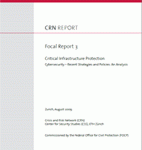
crnThe CSS Expert Community “Crisis and Risk Network” (CRN) has just released a new report on strategies and policies in the field of Cybersecurity. Based on the cybersecurity strategies of the US, the UK, NATO and other actors, the paper explores what cybersecurity actually means, puts forward possible responses to the perceived threats and discusses that with a focus on the Swiss situation. The authors argue that the underlying problem to cybersecurity policies is that it remains unclear what is threatened, who is threatening, and what the potential consequences of cyberattacks could be.
The paper can be downloaded here.

Categories
Uncategorized

SNIS Day 2 – The Policy Relevance of Research

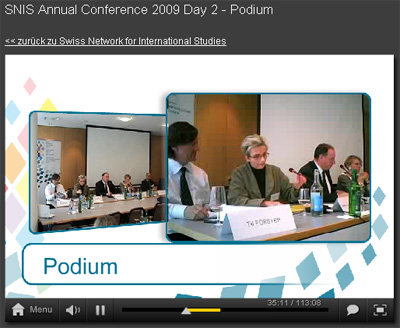
Video of the podium discussion, SNIS Conference, 16 October 2009

The second day of the SNIS conference was devoted to interaction between the academic and policy worlds (I introduced the conference in my previous post).

While everyone agreed that not all research must necessarily be policy relevant, the participants stressed the need for more cooperation.

The tension between demand-driven research and academic excellence dominated the discussions. On the one hand, research should provide information to help solve practical policy problems. On the other hand however, research must remain independent from the policy realm in order to guarantee objectivity and innovation.

A panelist argued that this tension was very present among European researchers, but that it didn’t bother US academics as much. Fellow Americans, if you read this, how did you solve the problem?

Here are a few (summarized) thoughts from panelists, both academics and policymakers.

Categories
Business and Finance

Swiss International Studies, Migration and Finance

Swiss Network for International Studies / snis.ch

I’m writing from Bern, where I’m attending the Swiss Network for International Studies‘ (SNIS) first yearly conference. The Network was established two years ago to promote interdisciplinary research in issues of international relevance among Swiss academics.

The international relations field is still pretty new at Swiss universities. It might well be a corollary of the fact that, for much of the past century, the country’s neutrality in international politics boiled down to passivity. Several speakers at the first day of the conference reminded us that Switzerland only joined the UN in 2002.

In any case, the young Swiss’ interest in international affairs is exploding at the moment: A Geneva professor talked to me about the exponential rise in student numbers since his university launched an undergraduate program in international relations.

Here are two highlights from the first day of the conference – based on my own biased personal interests…

Detours of Swiss Foreign Policy

Swiss Foreign Minister Micheline Calmy-Rey / Photo: Wikipedia

A new analysis by the ISN’s mother organization Center for Security Studies (CSS), Swiss Foreign Policy 2009: Crises and Challenges, discusses current issues of Switzerland’s foreign policy. Before the backdrop of conflicts over banking secrecy and the infamous clash with Libya, it looks at corner stones of Swiss foreign policy. Daniel Möckli especially highlights the domestically unpopular issue of a possible future EU membership.

You can download the paper here.