Pakistan: A Failed State?

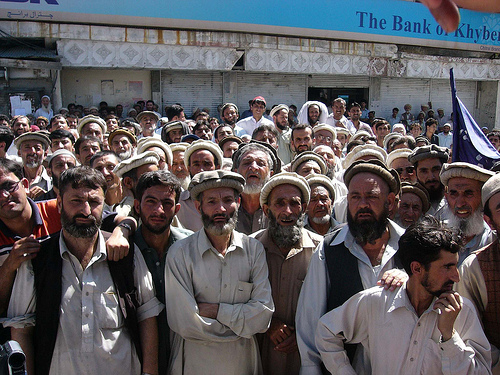
Pakistani protests over failed electricity distribution management. Photo: groundreporter/flickr

The term failed state is often used to describe a state perceived as having failed to meet some of the basic conditions and responsibilities of sovereign government. In international law, a failed state is one that, “though retaining legal capacity, has for all practical purposes lost the ability to exercise it.” According to the Fund for Peace that just released its seventh annual Failed State Index (FSI), a failed state is characterized by:

  1. loss of physical control of its territory or loss of the monopoly on the legitimate use of force;
  2. the erosion of legitimate authority to make collective decisions;
  3. an inability to provide reasonable public services; and
  4. an inability to interact with other states as a full member of the international community.

The FSI is made up of 12 social, economic and political indicators − each split into an average of 14 sub-indicators. The Fund for Peace bases its assessment primarily on content analysis of thousands of electronically available articles and reports that are processed by special software.

According to the latest index scores, Pakistan ranks 12th out of 177 countries examined.
A Timely Survey on Small Arms

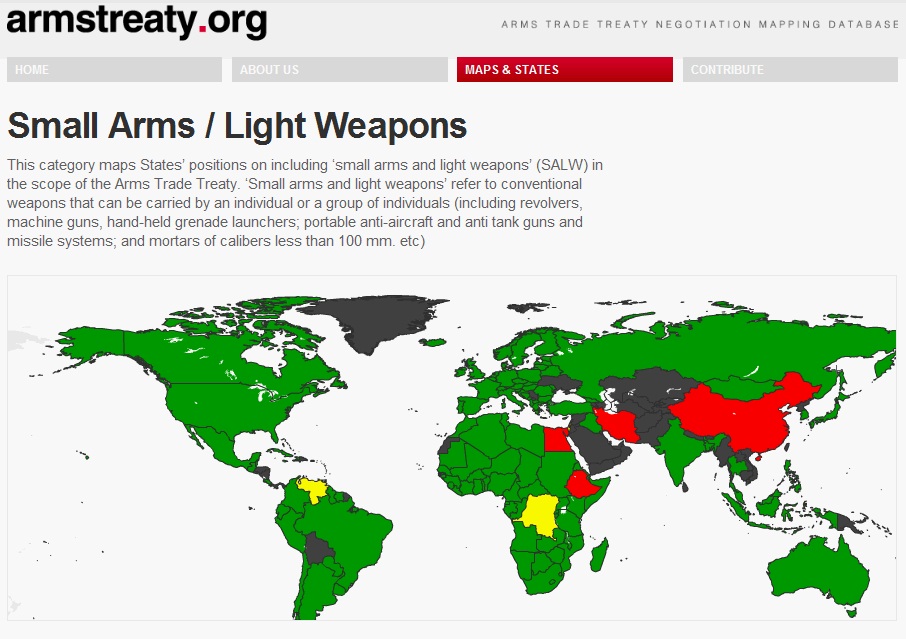
Most states support the inclusion of small arms and light weapons into the scope of the Arms Trade Treaty. China, Egypt, Ethiopia and Iran are the odd ones out. Screenshot from armstreaty.org

Private security companies (PMCs) employ twice as many people as police forces worldwide. Yet, PMCs only hold a fraction of the firearms possessed by law enforcement agencies.

This is one of the findings (pdf) presented in the Small Arms Survey 2011 published last week by the Graduate Institute of International and Development Studies in Geneva. This year’s theme is States of Security.  In the introduction, Robert Muggah, research director at Small Arms Survey, writes: “scholars and policy-makers are revisiting certain fundamental questions about security provision in the 21st century: Who actually provides security, and under whose authority?”

Apart from this special focus, which resulted in one chapter on private security and small arms, and another on multinational corporations and private security, the volume features statistics on small arms and light weapons (SALW) transfers. There we learn that the US, Italy, Germany, Brazil and Switzerland are the top exporters of SALW. The biggest importers are the US, Canada, the UK, Germany and Australia.

The Small Arms Trade Transparency Barometer reveals that Switzerland, the UK, Germany, Serbia and Romania are the most transparent among the big small arms exporters. It does not come as a surprise that Switzerland, the UK and Germany are also among the biggest sponsors of the Small Arms Survey research project. Nor is it surprising that Iran and North Korea are the two least transparent exporters of SALW.

The publication of the Small Arms Survey is timely:

Development Possibilities in the DPRK

Informal markets – pointing the way forward?
Informal markets – pointing the way forward? Image: fresh888/flickr

Next Tuesday, July 19th, ISN partner organization the United States Institute of Peace (USIP) will be hosting a one-day conference in Washington, DC exploring various transformations inside North Korea that will have significant implications for the regime, as well as for US policy toward North Korea. Speakers at the event include a group of Seoul-based North Korean defectors, as well as various USIP experts.

Informal Markets and Peacebuilding in North Korea” is part of a multi-stage USIP research project on informal markets in North Korea, drawing upon key findings from ongoing interviews with defectors, as well as the Northeast Asia Track 1.5 dialogues. With regard to North Korea, the role of informal markets is largely understudied: most research either focuses or speculates on nuclear weapons development, or troubled relations with South Korea, the US and other Asian states. This conference breaks new ground in examining the remarkable transformations that have been taking place at the local level: Informal markets constitute important coping mechanisms and survival strategies for members of diverse socioeconomic groups close to the Sino-North Korean border.

Categories
Uncategorized

This Week at the ISN…

It's week 28 on our editorial calendar, Photo: Leo Reynolds/flickr

This week the ISN will highlight the following topics:

  • In our ISN Insight for Monday, Dr Shalva Weil of the Hebrew University of Jerusalem investigates the history and disappearance of the largely unknown Jewish presence in Pakistan during much of the 20th century.
  • We feature a partner event on Tuesday: the upcoming US Institute of Peace conference on North Korea.
  • Wednesday’s ISN Insight explores the reasons behind the Czech Republic’s recent decision to scrap plans to participate in the US anti-ballistic missile defense system, thanks to a commentary from the founder and executive editor of Transitions Online, Jeremy Druker.
  • We’ll highlight an interactive map with a discussion of Pakistan as a potentially failed state on Thursday.
  • And our Friday podcast will discuss the current bloodshed in Sudan’s South Kordofan.

Integrity and Voodoo

Switzerland: The Disneyland of liberty? Photo: Loren Javier/flickr

Freedom House has long held the view that there is a correlation between human trafficking and despotic political regimes. If you read the latest world trafficking report by the US State Department and compare it with Freedom House’s most recent list, you’ll see what I mean.

The State Department’s report looks at the type and extent of trafficking activity, as well as the government response, in order to assess a country’s commitment to protecting human rights.

So, which country might we expect to be the most vigilant in ending modern day slavery?