
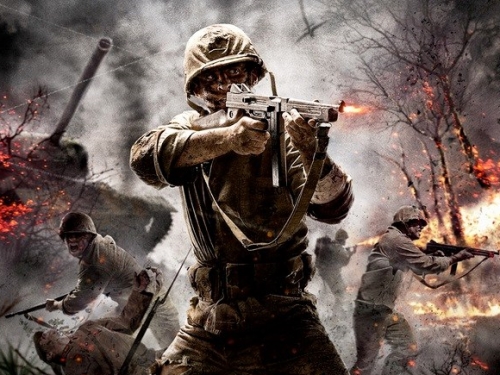
IR and the Future Wars of First-Person Military Shooters

Artwork for Call of Duty: World at War. Image: FireFishMike/Flickr

This article was originally published by E-International Relations on 9 October, 2014.

Game theorist McKenzie Wark has provocatively suggested that the four freedoms for which the US fought during WW2 – freedom of speech, freedom of worship, freedom from want, freedom from fear – have now been replaced by a new set in the wake of the invasions of Afghanistan and Iraq. These are “Freedom from religion, Freedom from speeches, Freedom to desire” and “Freedom from security”.[1]His Orwellian observation is that ”What secures the state is the production of insecurity”. In other words, the existence of a perpetual conflict, or the narrative of a perpetual conflict to be precise, creates a permanent sense of insecurity that legitimates any action taken by the security state, including the dismantling of civil rights or the pre-emptive invasion of other states.[2]

How (Not) To Write about African Wars

Rwandan genocide memorial church. Image: Adam Jones/Wikimedia

This article was originally published by the World Policy Institute on 30 September 2014.

Even a seasoned follower of political affairs might be excused for struggling to make sense of the seemingly worsening vortex of ongoing armed conflicts. Chances are, given the recent war in Gaza, the promising but still fragile developments in Afghanistan, and the twinned and tragic mess Syria and Iraq has become, his analytic brain might be reasonably overwhelmed.

But, to be sure, in the daily media discourse, some of the complicated nuances of these events have been gaining attention, making their way into public debates and helping form policy positions and diplomatic or military options. In short, news and information consumers are treated to a varied diet in relation to the coverage of world conflicts— most of which, in recent years, have been internal civil wars.

The argument holds, however, only if African civil wars are removed from the list. As it appears, those belong to a different category. For African civil wars, if the dominant media discourse is to be believed, explanations are easy and definitive.

Why “Call of Duty” May Not Help Us Predict Future Wars

“Call of Duty”- character. Image: Deviant-Dev/Deviantart

This article was originally published by War on the Rocks on 1 October 2014.

The Atlantic Council, seeking to enhance its exploration of the Future of Warfare with some new blood, recently hired Call of Duty: Black Ops series director Dave Anthony for an unpaid position as a senior fellow. At first glance, given the futuristic games Anthony has developed and the extensive consulting he has conducted with domain experts, the move seems like a no-brainer. Why not think outside the (policy) box with a man whose games rule the X-Box? Anthony’s Black Ops 2 in particular is seen by many defense analysts as a chilling vision of future warfare. However, this may have something to do with the fact that Anthony consulted many of them in the development process.

World War I and the Transformation of the World

British Vickers Machine Gun. Wikimedia Commons/John Warwick Brooke

This article was originally published by the Foreign Policy Research Institute (FPRI) in October 2014.

This summer marked the centennial of the outbreak of World War I, perhaps the most transformative war in history. While the wars of the French Revolution and the Napoleonic wars harnessed national populations in a way not previously seen since the emergence of the modern state system, World War I combined the mobilization of both populations and industrial power, enhanced by technology, to produce a most lethal form of warfare.

Can Afghanistan’s Unity Government Be Built to Govern?

Afghan President Ashraf Ghani with John Kerry. Image: US Dept. of State/Wikimedia

This article was originally published by IPI Global Observatory on 2 October, 2014.

The transfer of power on September 29 from President Hamid Karzai to his successor Ashraf Ghani was momentous but oddly anticlimactic. It was only possible after a highly controversial presidential election between Ghani and former foreign minister Abdullah Abdullah, which brought the country to the brink of chaos. Abdullah refused to recognize the results, which gave Ghani an overwhelming second-round victory. The United States negotiated a power-sharing deal where Ghani would become president, but a “chief executive officer” position would be created for Abdullah. The deal also prescribed an audit of the election supervised by the United Nations to identify and remove fraudulent votes.