
Categories
Uncategorized

This Week in ISN Insights…

It's week 16 on our 2011 editorial calendar, Photo: Christian Johannesen/flickr

Here’s a preview of what’s coming up this week in ISN Insights:

  • On Monday Dr Dean Baker – co-director of the Center for Economic Policy Research – opines about the European Central Bank’s fiscal policy failings in the wake of the financial crisis.
  • The Kofi Annan Foundation’s Albert Souza Mulli on Tuesday takes a closer look at Rio de Janeiro’s new Police Pacification Units – and the doctrinal and operational shift away from police ‘business as usual’ that they represent.
  • On Wednesday, the Foreign Policy Association’s senior health blogger, Cynthia Schweer, discusses community health worker programs as a possible solution to healthcare employee shortages in the developing world.
  • Dr Harsh Pant of King’s College London examines India’s struggle to balance strategic interests against national values in its support for the ongoing Libyan intervention on Thursday.

And in case you missed any of last week’s coverage, you can catch up here with articles on: fallout from the Haitian presidential election; the 50th anniversary of human space flight; turbulence ahead of Finland’s general elections; the EU’s response to endemic corruption in Romania; tension surrounding Sudan’s disputed Abyei province; and a podcast on chronic poverty.
Repatriation of Migrant Workers from Libya

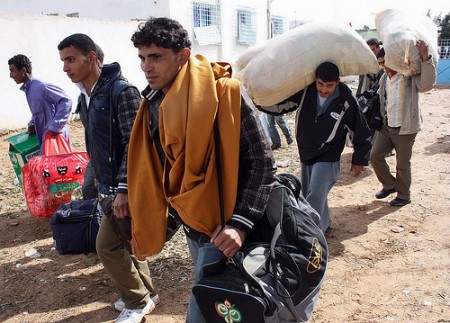
Let's go home. Photo: magharebia/flickr

The Kuwait Times reports that before the uprising, there were some 2.5 million migrant workers from various countries in Libya. Some have since returned to their native country on their own, while some required consular or diplomatic assistance. According to international migration officials, 191,748 foreign migrant workers have already left Libya. Of these, 104,275 crossed into Tunisia, 84,973 to Egypt, 2,500 to Niger and 4,000 went to Algeria.

The situation of the remaining migrant workers is tenuous: They have been left to fend for themselves, after employers abandoned them. Unskilled workers do not dare go out as they are fearful of being shot, either by protesters or by forces loyal to Muammar al-Gaddafi. With food, water and medicine shortages, local shops are selling the few available products to Libyan citizens, not migrant workers. This has meant some workers have no money or food, and are approaching the verge of starvation.

The governments of developing countries in Asia – such as Bangladesh, the Philippines, Thailand, and India – are struggling to evacuate their nationals from Libya. Among the masses of foreign workers trapped in Libya and desperate to leave, migrants from Bangladesh comprise the largest number of foreigners ensnared in the crisis and unable to flee.

In a recent article, World Bank senior economist Jahed Hossain Khan said that the World Bank will loan Bangladesh $30 million for the evacuation of expatriates from Libya.

How to Prevent Economic Crises

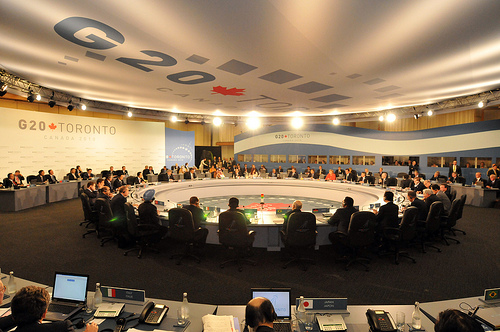
G20 Summit, courtesy of The Prime Minister's Office/flickr (Crown Copyright)

The global economy is strongly integrated, and domestic economic policies are strongly… well, domestic.

A landmark report by Chatham House and the Centre for International Governance Innovation (CIGI) argues that the way in which nations design their economic policies is woefully inadequate to prevent financial and economic crises.

Entitled “Preventing Crises and Promoting Economic Growth: A Framework for International Policy Cooperation“, the report is the outcome of a nine-month international research project. Authors Paola Subacchi and Paul Jenkins consulted with finance and foreign affairs ministries, multilateral institutions and research institutes in Europe, Asia and North America.

They call for national policy-makers to recognize the spillover effects of their policies on other countries as well on the wider economic system. In practice, this would mean accompanying internationally relevant domestic policies by “international impact assessments”.

The report also proposes a new framework for G20 policy cooperation. Indeed, cooperation tends to be “only feasible when interdependencies are made clear by incidents of instability and volatility as happens during crises, i.e. when the costs of non-cooperation are painfully evident“.

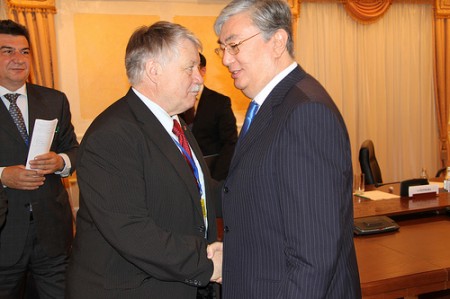
Goodluck, Nigeria and Kazakhstan

Your boss promised us to play it fair this time. Photo: oscepa/flickr

Nigerians finally cast their votes for a new national assembly last Saturday, in the first of three successive elections. It did not start quite as imagined. A week earlier, polling had to be abandoned after election materials failed to arrive in many parts of the country. A bomb blast at an electoral office on the eve of the election killed several people, and polling itself was marred by sporadic violence.

But compared to the 2007 elections, which were characterized by violence, organized vote-rigging and fraud, Nigeria might do pretty well this time. A well respected academic and civil society activist presides over the Independent National Election Commission, and incumbent President Goodluck Jonathan has made repeated commitments to respect the rules of democracy. His main challengers include a former military ruler, who is now taking his chances at the polls. And even the estimated 10 to 15 percent ghost voters do not seem so bad after all. Progress is relative. According to one of Crisis Group’s Senior Analysts, “The polls could mark a turning point for Nigeria”.

The same cannot be said for Kazakhstan. In a sham election earlier this month, President Nursultan Nazarbayev won 95.5% of the votes in a turnout of 89.5%. Nazarbayev’s three challengers all expressed support for his candidacy and, bizarrely, one of them even admitted having voted for him. The way in which the elections took place not only embarrasses Western diplomats, whose praise for the call for elections now seems somewhat premature.

Categories
Uncategorized

This Week in ISN Insights…

It's week 15 on our 2011 editorial calendar, Photo: Don Shall/flickr

Here’s a peek at our ISN Insights line-up for the week:

  • On Monday, Dr Markus Schultz-Kraft from the Institute of Development Studies at the University of Sussex outlines a path toward better governance for Haiti in the wake of Michel Martelly’s election.
  • University of St Andrews Professor Gerard DeGroot reflects Tuesday on the 50-year anniversary of the first manned-space flight – and cautions emerging powers to develop smarter space policies than their Western counterparts.
  • On Wednesday, Dr Teija Tiilikainen, director of the Finnish Institute of International Affairs, analyzes the turbulence that has preceded Finland’s 17 April general elections.
  • Press Freedom Award-winning journalist Anca Paduraru on Thursday investigates the recent crackdowns on endemic corruption in Romania, which are widely perceived to be little more than ‘show operations’ designed to appease an uneasy EU.
  • Friday’s podcast takes a closer look at chronic poverty, thanks to an interview with Dr Andrew Shepherd of the Chronic Poverty Research Center.

And if you missed any of our special coverage of Euro-Muslim relations last week courtesy of our 2010 Junior Associates, you can catch up here with articles about: Islamophobia’s sources and cures; counter-radicalization policy in a divided Britain; EU-Maghreb counterterrorism cooperation; and Turkey’s geostrategic role in Euro-Muslim relations.