Barack Obama, The Peacemaker

Jagland and Obama. Source: Official White House Photo by Samantha Appleton

This article was originally published April 21 2014 by World Policy Blog.

Less than two weeks after Barack Obama assumed the Presidency of the United States, he was nominated for the 2009 Nobel Peace Prize. Several months later, primarily on the basis of his eloquent speeches rather than his accomplishments, he was awarded that coveted recognition.

In his acceptance speech, Obama said he was “surprised” and “deeply humbled” by the award, but didn’t really feel deserving of the honor.

Now, after nearly six years of pursuing his strategy of reaching out a friendly hand of accommodation to adversaries, rather than what he considered George Bush’s menacing fist, and of disengaging the United States from increasingly unpopular wars and entanglements, has he lived up to the hopes and expectations of the Noble Prize Committee or of American voters?

A New Plan to Halt the Downward Spiral of the SA Defence Force

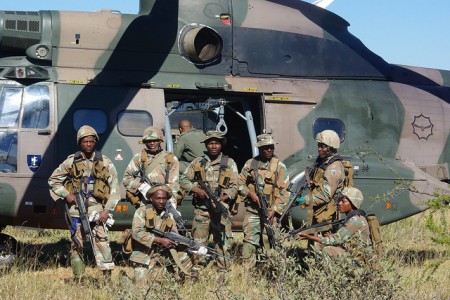
Roodewal Weapons Range 09/05/13
Image: Flickr

Editor’s note: This article was originally published by the Institute for Security Studies on 7 April 2014.

After being in limbo for almost 16 years, with no review of its role since 1998, the South African National Defence Force (SANDF) now has a new blueprint for the future. The 2014 Defence Review was approved by cabinet and has been cleared for publication, following a lengthy process that started in mid-2011. It takes into account South Africa’s increasing role in peacekeeping in Africa and will form a basis for funding allocated to the military. However, the strategy should be implemented soon to stop the decline of the defence sector that has resulted from a lack of funds and overstretching of its capabilities.

Years of under-spending and a mismatch between missions and funding have had dramatic consequences. For example, where the 1998 Review provided for one battalion to be deployed externally for a year, the SANDF has had at least two battalions deployed for peacekeeping since 2001 – three for a decade and briefly four – along with smaller elements. Today it has a battalion group in the Democratic Republic of Congo (DRC), plus a battalion in Darfur and a frigate in the Mozambique Channel. In the interim, the government also changed its mind and instructed the SANDF to again take over responsibility for border safeguarding.

Categories
Regional Stability

Kosovo: Time for a Restart between Pristina and the North?

Young Kosovo. Source: Tony Bowden

It was hoped that the Brussels Agreement would lead to the normalization of relations between Kosovo and Serbia and stabilize the situation in Northern Kosovo in the process. Yet, while it’s true that ties between Pristina and Belgrade have improved, the same cannot be said about the Kosovar capital’s relations with its restive northern territory. Indeed, Pristina still lacks a dialogue with the Serbian minority in the north. Will a change of government help to rectify this situation?

Obama Administration Decision Weakens New START Implementation

START Treaty meeting
Image: Wikimedia

This article was originally published by the Federation of American Scientists

After four years of internal deliberations, the U.S. Air Force has decided to empty 50 Minuteman III ICBMs from 50 of the nation’s 450 ICBM silos. Instead of destroying the empty silos, however, they will be kept “warm” to allow reloading the missiles in the future if necessary.

The decision to retain the silos rather than destroy them is in sharp contrast to the destruction of 100 empty silos currently underway at Malmstrom AFB and F.E. Warren AFB. Those silos were emptied of Minuteman and MX ICBMs in 2005-2008 by the Bush administration and are scheduled to be destroyed by 2016.

Is Transnistria the Next Crimea?

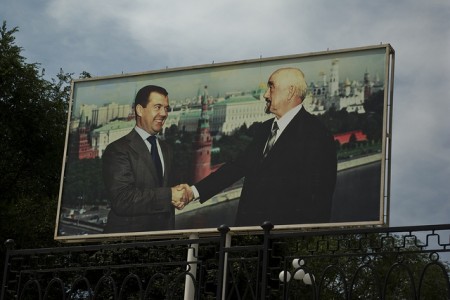
Medvedev in Trasnistria
Image: flickr

Editor’s note: This article was originally published by PISM on 11 April 2014.

Speeding up Association after Ukraine
If just a year ago Moldova’s reputation as a front runner in the Eastern Partnership (EaP) was endangered by a months-long domestic political crisis, the new Pro-European Coalition (PEC), in place since 30 May 2013, has so far demonstrated relative stability and an ability to withstand Russian pressure. Yet such political determination would not have been sufficient had it not been for the developments in Ukraine—first the EuroMaidan protests and then the crisis in Crimea—which made the EU understand the threats to the association process if prolonged further. As such, an Association Agreement (AA) with Moldova was initialled at the Vilnius Summit in November 2013 and is planned to be signed as soon as in June. Visa liberalisation was also accelerated and finalised: in mid-November the European Commission announced completion of the implementation of the visa liberalisation action plan, and visa requirements will be abolished for Moldovans (holding a biometric passport) from 28th April. The technical progress of association is also accompanied by more financial support and a visible intensification of political backing from the West, translated into frequent high-level visits to Chisinau.