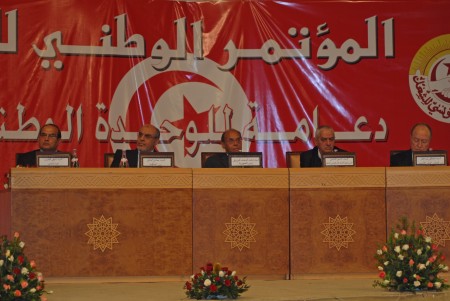
The adoption of a new Tunisian constitution at the end of January has been hailed as a major milestone in the country’s democratic transition and a welcome piece of good news amid concerns about the direction of transition processes in other countries in the region.
From a mediation perspective, the national dialogue process that brought Tunisia to this point is noteworthy for at least two reasons. First, the mediators in this case were insiders with a stake in the outcome. Second, changes in context, beyond the control of either party, significantly altered the strategic calculations of the negotiators and opened the window to an agreement.
It is often said that the rise of military robotics and cyber warfare is turning war into a “videogame.” But this thesis—which blames technology for a supposed loss of moral seriousness about war—gets the causation wrong. It isn’t bloodless technology that really makes war videogame-like. Rather, videogames are simple and deterministic in that they mirror the ways a cross-section of national security experts think about war. It seems that as hard as we try to be treat war as “tragic, inefficient, and uncertain,” we end up getting our military analysis from the same mental place that’s engaged by a shopping trip to GameSpot. We might as well use this to our advantage by diversifying our unconscious war(games) rather than playing the same titles over and over again.One of the most common tropes in both military analysis and popular culture is the danger of war becoming a “videogame.” From Matthew Broderick’s “game” with a military supercomputer in WarGamesto Robert Gates’ recent criticism of drone warfare, there is a strong tendency to equate technology with both dehumanization as well as an overly stilted and abstract view of conflict. While this sort of rhetoric is primarily deployed to critique drones and other standoff technologies, it also is used to bashmathematical or computational methods of analysis. Quoth Gates:
For too many people—including defense “experts,” members of Congress, executive branch officials and ordinary citizens—war has become a kind of videogame or action movie: bloodless, painless and odorless. But my years at the Pentagon left me even more skeptical of systems analysis, computer models, game theories or doctrines that suggest that war is anything other than tragic, inefficient and uncertain.
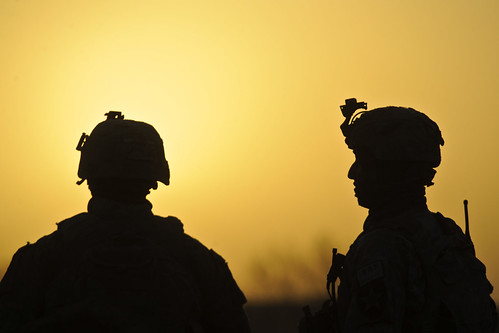
There will be no more large-scale American counterinsurgency operations. At least, that’s what the Obama administration’s Defense Strategic Guidance (DSG) of 2012 anticipates. While it maintains an existing emphasis on countering irregular threats and conserving hard-won skill sets, the DSG articulates a desire to do so not through large-scale counterinsurgency, but by maintaining a persistent, forward presence around the world and leveraging that presence to deter potential adversaries, respond to crises, and build the capacity of partner nations to provide for their own security. Specifically regarding the latter, the document states,
Across the globe we will seek to be the security partner of choice, pursuing new partnerships with a growing number of nations – including those in
Africa and Latin America – whose interests and viewpoints are merging into a common vision of freedom, stability, and prosperity. Whenever possible, we will develop innovative, low-cost, and small-footprint approaches to achieve our security objectives… [Emphasis in the
original]
The “small-footprint approach” is a lynchpin of the DSG, and has led to a number of initiatives within the military services, such as the Marine Corps’ establishment of several Special Purpose Marine Air Ground Task Forces (SPMAGTFs) focused on Africa or the U.S. Army’s Regionally Aligned Brigades (RABs). Yet, the discussion of the implications of the emphasis on small footprint for U.S. foreign policy, and for the U.S. military, has only just begun.
The crisis in Venezuela has escalated beyond the capacity of domestic actors to find a space for dialogue. Each party rejects the legitimacy of its rival. Human rights violations – and protester violence – are leaving deep wounds in Venezuelan society that will take years to heal. Not long ago, such an impasse would have prompted the immediate response of the international community and particularly of regional organisations such as the Organization of American States (OAS). But Latin America is dividing against itself, and Venezuelans are paying the price.
During and after democratic transitions in the hemisphere’s southern cone and the negotiated peace of armed conflicts in Central America (1983-1996), the region built a credible system to protect human rights. The Inter-American Commission and Court on Human Rights, whose competence and jurisdiction were recognised by almost all American nations (with the notable exceptions of Canada, Cuba, and the U.S.), established standards to sanction past and present human rights violations. In 2001, the OAS, at the culmination of this expansive process, adopted the Inter-American Democratic Charter to protect and promote democracy and the rule of law, understanding that these were vital components of free societies.
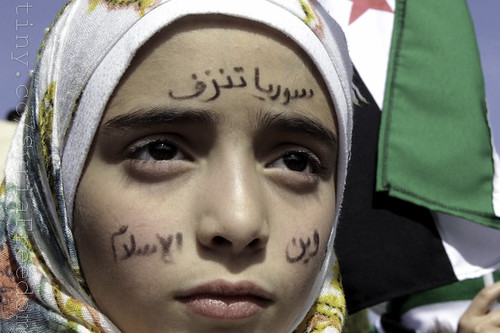
Young girl protesting outside US Embassy in Amman, courtesy of Freedom House/flickr
CAMBRIDGE – More than 130,000 people are said to have died in Syria’s civil war. United Nations reports of atrocities, Internet images of attacks on civilians, and accounts of suffering refugees rend our hearts. But what is to be done – and by whom?
Recently, the Canadian scholar-politician Michael Ignatieff urged US President Barack Obama to impose a no-fly zone over Syria, despite the near-certainty that Russia would veto the United Nations Security Council resolution needed to legalize such a move. In Ignatieff’s view, if Syrian President Bashar al-Assad is allowed to prevail, his forces will obliterate the remaining Sunni insurgents – at least for now; with hatreds inflamed, blood eventually will flow again.