
Hard Power and the “Rational” Approach of Enlightenment Era Thinkers (Part 2/8)

Photo: David Ian Roberts/flickr

As we discussed yesterday, Raimondo Montecuccoli, along with contemporary military engineers like Sébastien Vauban and Blaise de Pagan, provided a significant link between the broadly prescriptive military theorists that preceded them and the rigid mechanical-mathematical treatments of hard power that subsequently appeared during the Enlightenment.  The military rationalists of that era, including Frederick the Great, Henry Lloyd, Heinrich von Bülow, Antoine-Henri Jomini, and a collection of lesser lights that went by the collective (and telling) name of the Auteurs Dogmatiques all embraced the linear thinking of the New Physics or “Natural Philosophy” of the 18th century.  (The latter group included the now largely forgotten Marquise de Santa Cruz, the Marquise de Feuquières, Marshal Puységur and other creatures very much of their time.)

They categorically rejected the spit-into-the-wind thinking of Marshal Maurice de Saxe, who famously characterized war as “a science so obscure and imperfect” that “custom and prejudice, confirmed by ignorance, were its only foundations and support.” (My translation.)   Instead, the soldier-thinkers of the Enlightenment embraced the intelligible, mathematical logic of Isaac Newton and his disciples.  That Newton wasn’t actually as irremediably linear and mechanistic as they believed was beside the point.  These men in arms were convinced that reality was “out there.”

Past, Present and Future Ways of Bounding Hard Power and War: An Eight-Part Blog

Photo: Steve Drolet

This week and the next, the ISN website will be concentrating on the problem of future forecasting. If the international system today is indeed undergoing core-level changes, then trying to understand where these changes might be taking us becomes important – not just in general, but in the case of how future belligerents might use what has become popularly known as hard power.

We know, however, that a robust contemplation of the future must be grounded in the past. Effective futurology, in other words, requires context. That is why before I contemplate the future of organized violence I’d like to perform a little history – i.e., I’d like to begin with a proposition that will also serve as my core theme over the next eight blog posts.

It goes as follows: Up through the late 20th century, concepts of military or hard power were inescapably entangled with the two characterizations of war that have dominated the modern era – 1) the “rational” pseudo-scientific approach of Renaissance and Enlightenment thinkers, and 2) the “irrational,” 19th century approach of military romantics. Both approaches are not totally “reality inclusive,” and because they first – and naturally – focused on the collision of hostile armies over disputed territory, they eventually trapped those who thought about the utility (or not) of war within a prison house of language. That trap lasted at least until the 1990s, at which point new ways of characterizing hard power appeared. These new ways, however, represented (and still do) a way back to the future, if anything else.

ISN Editorial Plan Starts: Future Forecasting

The future is this way. Photo: Michelle Bartholomew/flickr

Dear Colleagues:

Last week we provided a General Introduction to the three-part Editorial Plan we would like to explore on the ISN website in the weeks and months ahead. Well, our plan begins today and our first broad area of inquiry will be on the macroscopic structural changes we are experiencing in the international system. To analyze this large-scale topic properly, over the next 14 weeks we plan on exploring the 8 supporting sub-topics we identified in Part 1 of the General Introduction, including what many have come to call “futurology”:

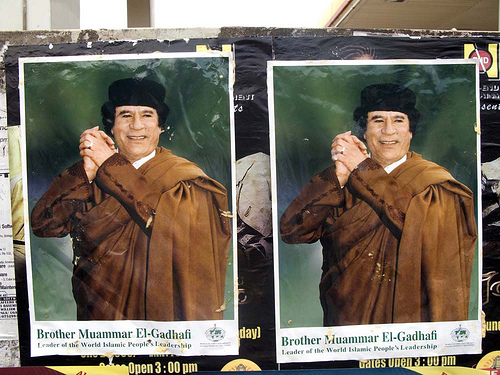
Dancing With the Devil – Dealing With Gaddafi

Photo: donjohann/flickr

Sometimes there are articles that simply get under my skin and that create a pesky need to address them individually. John Deverell’s op-ed in The Guardian, There’s no shame in talking to people like Gaddafi, was one of those pieces.

Deverell is a British military figure who notes, with obvious pride, that he was involved in negotiations between the UK and Gaddafi. He is frustrated with a trend of criticizing the British government and institutions over their relationship with Gaddafi:

“it has become politically expedient to decry the relationship fostered since 2003 between the last British government and Gaddafi’s regime.

Former prime minister Tony Blair, officers from the British secret intelligence service, the London School of Economics ( in the news again last week): all have been criticised for the personal relationships they built with senior Libyans, to the extent of being accused of turning a blind eye to human rights and other abuses.”

Charles Tilly, AD 990-1992: Twenty Years On

The French Revolution
According to Tilly, the French Revolution (a milestone in the civilanization of French politics) emerged from protests against the high taxes French Rulers imposed to compensate for the costly American War. Photo: Wikimedia Commons

The other day I was re-reading what should perhaps be on every politics student’s bookshelf, Coercion, Capital and European States: AD 990-1992 by Charles Tilly. In this book Tilly examines what formed the modern state by looking at the impact of Europe’s violent history. In contrast to other theories like the idea of a social contract, Tilly argues that: “War wove the European network of national states, and preparation for war created the internal structures of states within it.” The European welfare state as we know it today, Tilly argues, occurred as an inadvertent spin-off from rulers’ bargaining with subject populations when seeking to extract the means to wage war. In exchange for giving up their most valuable resources (sons, lands, weapons, animals), citizens were granted civil rights, social benefits and protection by the state in return.

Throughout the more than 200 pages of historical anecdotes, AD 990-1992 develops a convincing argument that it was indeed rulers’ zeal for developing and adapting to new types of war – thus changing the nature of political-bargaining – that pushed state-transformation. For example, in Revolutionary France the public only agreed to mass disarmament and conscription in exchange for rights of civil suit, local assembly and social benefits.