
‘Hybrid War’ and ‘Little Green Men’: How It Works, and How It Doesn’t

Masked soldiers in Crimea. Image: E. Arrott/Wikimedia

This article was originally published by E-International Relations on 16 April 2015. It is an excerpt from E-IR’s Edited Collection “Ukraine and Russia: People, Politics, Propaganda and Perspectives”.

When Russian special forces seized Crimea at the end of February 2014, without their insignia, but with the latest military kit, it seemed as the start of a new era of warfare. Certainly, the conflict in Ukraine has demonstrated that Moscow, in a bid to square its regional ambitions with its sharply limited resources, has assiduously and effectively developed a new style of ‘guerrilla geopolitics’ which leverages its capacity for misdirection, bluff, intelligence operations, and targeted violence to maximise its opportunities. However, it is too soon to declare that this represents some transformative novelty, because Moscow’s Ukrainian adventures have not only demonstrated the power of such ‘hybrid’ or ‘non-linear’ ways of warfare, but also their distinct limitations.

Categories
Terrorism Global Voices Regional Stability

Al-Shabaab’s Kenyan Ambitions

The flag of the terrorist group ‘Al-Shabaab’. Image: Ingoman/Wikimedia

This article was originally published by the International Crisis Group on its ‘In Pursuit of Peace’- Blog on 15 April 2015.

Why is Al-Shabaab increasingly targeting Kenya?

In its statement following the attack, Al-Shabaab claimed it acted to avenge atrocities it alleges have been committed by the Kenyan military deployed in Somalia (now part of the African Union peace-support operation AMISOM). This puts pressure on the Kenyan commitment to that mission. Al-Shabaab also claimed that its fight is to liberate “all Muslim lands under Kenyan occupation”, including “north-astern province and the coast”. Despite being anachronistic given Kenya’s recent divisions into county based government, this language chimes with pan-Somali nationalist and irredentist slogans of the 1960s and 70s.

What Do Brazilian Admirals Want? Not a Quiet Expansion!

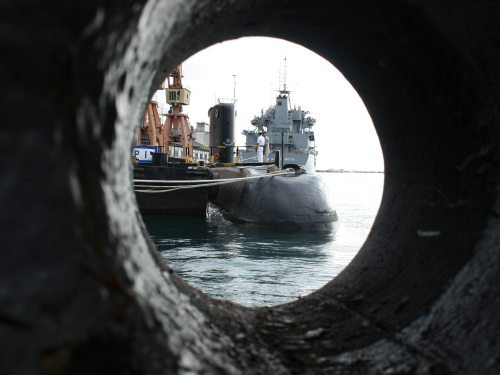
A Brazilian submarine docking at a port. Image: Edoardo Pelosi/Flickr

This article was originally published by Security Dilemmas on 22 April, 2015 and has also been published on Daniel Rio Tinto’s blog Imminent Crisis.

The Swiss blog Offiziere.ch has recently published a piece by Paul Pryce, analysing the Brazilian Navy’s current endeavours whilst trying to figure out what bearing it is sailing. Pryce evaluates the ‘quiet expansion’ of the Brazilian Navy, and whilst he delivers a brief but sound level of analysis, he fails to deliver an accurate reading of some of the key underlying issues. These issues include the ‘military industrial compound’ dimension of the Navy, the often unspoken aspects of civil-military relations in Brazil and the competition for budget between branches.

Categories
Regional Stability

Turkey’s Ethnic Armenians Wary About Future

Armenian flags in front of a mosque in Lebanon during an anti-Turkish protest. Image: Harout Arabian/Flickr

This article was originally published by EurasiaNet on 14 April 2015.

The 100th anniversary [on April 24th] of the Medz Yeghern, or the “Great Catastrophe,” [has] highlight[ed] the mixed feelings that Turkey’s tiny ethnic Armenian minority has for President Recep Tayyip Erdoğan’s administration.

On April 24, Armenians around the world [marked] the World-War-I-era deaths of hundreds of thousands ethnic Armenians in Ottoman-era Turkey. It is a tragedy that for many historians and analysts constitutes an act of genocide.

Turkey denies the claim of genocide. On April 12, Ankara withdrew its ambassador from the Vatican after Pope Francis termed the massacre “the first genocide of the 20th century.”

Focusing Like a Laser Beam on Directed Energy

Soviet Ground-based Laser. Image: Edward L. Cooper/Wikimedia

This article was originally published by War on the Rocks on 14 April, 2015.

Advocates have long argued that directed energy weapons — including high energy lasers, high power microwaves, and other radiofrequency technologies — may carry substantial operational advantages for U.S. forces. None other than Deputy Secretary of Defense Robert Work has called high energy lasers an example of the “fantastic, potentially game changing new technologies that we can more quickly get into the force,” and one candidate for the new “offset” strategy pursued by the Department of Defense. In principle, directed energy weapons can provide offensive and defensive non-kinetic attack options, serve as cost-effective force multipliers, and provide operational flexibility to the warfighter.

In parallel, skeptics point to a lengthy track record of overhyped promises and system underperformance. They note that the large-scale, high-profile developments of the 1980s, 1990s, and 2000s — programs such as the airborne, ground-based, or space-based lasers — were not only costly but ultimately failed to transition into the U.S. arsenal. They often argue that technically credible, operationally usable, and policy friendly directed energy weapons have been more the province of science fiction than reality.