
‘Land Grabbing:’ Taking Stock of Two Years of Debate

The romanticization of farmland is part of the debate. Image: David M. Wright/flickr

“Whether viewed as ‘land grabs’ or as agricultural investment for development, large-scale land deals by investors in developing countries are generating considerable attention. However, investors, policymakers, officials, and other key stakeholders have paid little attention to a dimension of these deals essential to truly understanding their impact: gender.” (The Gender Implications of Large-scale Land Deals, IFPRI, April 2011).

Two years after the publication of “‘Land Grabbing’ by Foreign Investors in Developing Countries,” the International Food Policy Research Institute (IFPRI) is again setting the agenda. The idea that we should consider gender issues when evaluating large-scale land deals shows how the ‘land grabbing’ debate has matured since it started in 2009, when rich investors from powerful countries were pitted against poor farmers in developing countries.

Of course, there are still those who condemn greedy land grabbers abusing their power to deprive poor Africans of their land, on the one side, and those who hail benevolent investors lending their money to develop backward agriculture in the ‘south’ on the other. But we can also observe many shades of gray in a debate which seems to have revived in spring 2011.
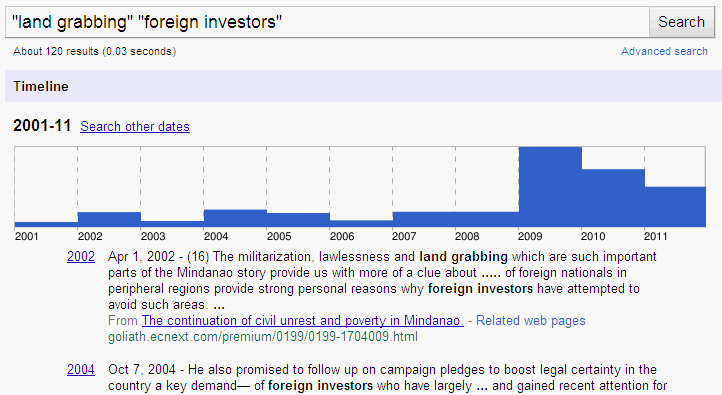
A Google Timeline search shows how the 'land grabbing' debate really started in 2009. After it cooled down a bit in 2010, it seems to have revived in 2011: not yet half into the year, the bar already shows about half of the results found for 2009.

Two years into the ‘land grabbing’ phenomenon, here are some resources on the issue.

Geopolitics and Law at Sea

China is betting on energy under the ‘South China Sea.’ Photo: offshorinjurylawyer/flickr

This week in New York, the state parties to the UN Convention on the Law of the Sea (UNCLOS) are meeting for the 21st time since the convention’s conclusion in 1982. Major items on the agenda are the reports of the ongoing work of the Convention’s three main organs: 1) the International Tribunal for the Law of the Sea (ITLS), which interprets the Convention and adjudicates disputes 2) the Commission on the Limits of the Continental Shelf (CLCS), which evaluates geological and oceanographic data, and 3) the International Seabed Authority (ISA), which organizes and controls activities related to the sea floor, which lies beyond national jurisdictions.

Three main items are currently before the Tribunal: a boundary dispute between Bangladesh and Myanmar in the Bay of Bengal (of special relevance to Conoco Phillips); the M/V Louisa case, a dispute arising from Spain’s detention since 2006 of the eponymous research vessel, which was flying the flag of St Vincent and the Grenadines in Spanish coastal waters while conducting scientific surveys of the sea floor; and a request for an advisory opinion from the Tribunal on the status of state parties sponsoring private activities on the sea floors outside national jurisdictions, a case arising from commercial activities proposed by Nauru Ocean Resources Inc. and Tonga Offshore Mining Ltd.

While these are hardly the issues making international headlines – and the above two companies remain unlikely, to say the least, to ever become major global players in natural resources – the Law of the Sea can be a genuine battleground of great power politics.

Gorkhaland for Sale

Gorkhaland: compromise or sell out? Photo: Rak’s/flickr

The newly elected Chief Minister of West Bengal, Mamata Banerjee, announced on 7 June that the West Bengal state government has come to an agreement with the Gorkha Janmukti Morcha (GJM), the party leading the agitation for a separate Gorkha state since 2007. Gorkhaland was supposed to be carved out of West Bengal in India and encompass the current district of Darjeeling in the Himalayan foothills.

Darjeeling district is culturally distinct from the rest of the state by its primary language (Nepali instead of Bengali) and its character as a melting pot of religions and ethnicities (various indigenous tribes and immigrants from Nepal, Tibet and Bhutan). Now the leaders of the GJM have dropped the demand for a separate state and instead reached an agreement with the West Bengal government to form a new hill council with elected representatives to govern in a semi-autonomous fashion.

It seems that history has just repeated itself. The demand for a separate state of Gorkhaland is not new. In the 1980s, Subhas Ghisingh and his Gorkha National Liberation Front (GNLF) led a violent two-year conflict for a separate Gorkhaland state. In 1988 Ghisingh accepted a political settlement, signing a tripartite agreement with the governments in Kolkata and New Delhi that gave partial autonomy to the Darjeeling Gorkha Hill Council (DGCH), the governing body for the district of Darjeeling.

Categories
Uncategorized

This Week in ISN Insights…

It's week 24 on our editorial calendar, Photo: Leo Reynolds, flickr

Coming up this week in our truncated ISN Insights coverage (in light of Monday’s Swiss national holiday):

  • On Tuesday, Simon Saradzhyan of Harvard University’s Belfer Center comments on a historic opportunity for European missile defense in the making.
  • University of St Andrews Professor Gerard DeGroot takes a closer look on Wednesday at mainstreaming gender in UN peace operations.
  • On Thursday, Professor Plamen Pantev of Sofia University addresses the question: Where do the western Balkans stand after the arrest of Ratko Mladic?

And in case you missed any of last week’s articles, you can find them here on: the growing scourge of transnational organized crime; the overblown threat of nuclear weapons; understanding the process from radicalization to terrorism; and a preview of Turkey’s general elections.

Categories
Uncategorized

Shape the ISN’s Future


Access to information is no longer the main problem. Today’s challenge is managing the information that’s out there. For almost two decades, the ISN has been dedicated to promote information management and knowledge sharing in the area of international relations and security. We are striving to integrate original current affairs analysis with existing background publications and policy briefs. We offer you a wealth of free, high-quality information services, but we know that we don’t always present it in the best way possible. That’s where we need your help.

We are curious to hear which services you use, which regions and topics you’re interested in, which new services you’d like us to provide and how we can make our website more user-friendly. Please take a few minutes and give us your feedback on how we can improve. We highly appreciate your opinion.


Take me to the survey